CROATIA

Enter where you want to go and what you want to do and TripAtlas PROs will work with you to build your dream trip Browse pre-built trips created by our TripAtlas PROs & customize them to your needs

'Croatia' (), officially the 'Republic of Croatia' (''Republika Hrvatska'' ), is a country at the crossroads of the Mediterranean, Central Europe and the Balkans. Its capital is Zagreb. Croatia borders with Slovenia and Hungary to the north, Serbia to the east, Bosnia and Herzegovina to the south and east, Montenegro to the far south, and the Adriatic Sea to the west. Croatia is a candidate for membership of the European Union and NATO.

Contents
History
Geography
Politics
Counties
Economy
Demographics
Culture
See also
References
Notes
Further reading
External links

History


Main articles: History of Croatia

Satellite image of Croatia

The Croats settled in the Balkans in the early 7th century and formed two principalities: Dalmatia and Pannonia. The establishment of the Trpimirović dynasty ca 850 brought strengthening to the Dalmatian Croat Duchy, which together with the Pannonian principality became a Kingdom in 925 under King Tomislav.
In 1102, Croatia entered into a personal union with the Hungarian Kingdom. After the 1526 Battle of Mohács the "reliquiae reliquiarum" (''remnants of the remnants'') of Croatia became a part of the Habsburg Monarchy in 1527.
It was part of the Kingdom of Serbs, Croats and Slovenes, from 1918-1929, and Kingdom of Yugoslavia, from 1929-1941.
In 1941-1945 an Axis puppet-state known as the Independent State of Croatia was set up, and after the victory of the Allies, Croatia became a republic within the Yugoslavia federation.
In 1991 Croatia declared independence and a bitter and costly war was fought by the Croatian government against the invading Serb-led Yugoslav People's Army, Serbian paramilitary forces and rebel Serbs. Later the war mutated into a conflict between independent Croatia and the rebel Serbs, with the support of Serbia proper. The war came to and end with signing of the Dayton Agreement in 1995.

Geography


Map of Croatia

Main articles: Geography of Croatia

Croatia is located in Southern Europe. Its shape resembles that of a crescent or a horseshoe, which flanks its neighbours Serbia, Bosnia and Herzegovina and Montenegro. To the north lie Slovenia and Hungary; Italy lies across the Adriatic Sea. Its mainland territory is split in two non-contiguous parts by the short coastline of Bosnia and Herzegovina around Neum.
Its terrain is diverse, including:

★ plains, lakes and rolling hills in the continental north and northeast (Central Croatia and Slavonia, part of the Pannonian Basin);

★ densely wooded mountains in Lika and Gorski Kotar, part of the Dinaric Alps;

★ rocky coastlines on the Adriatic Sea (Istria, Northern Seacoast and Dalmatia).
The country is famous for its many national parks.
Croatia has a mixture of climates. In the north and east it is continental, Mediterranean along the coast and a semi-highland and highland climate in the south-central region. Offshore Croatia consists of over one thousand islands varying in size.
''National Geographic Adventure Magazine'' named Croatia as Destination of the Year in 2006.[1]

Politics


Main articles: Politics of Croatia

Since the adoption of the 1990 Constitution, Croatia has been a democratic republic. Between 1990 and 2000 it had a semi-presidential system, and since 2000 it has a parliamentary system.
The President of the Republic (''Predsjednik'') is the head of state, directly elected to a five-year term and is limited by the Constitution to a maximum of two terms. In addition to being the commander in chief of the armed forces, the president has the procedural duty of appointing the Prime minister with the consent of the Parliament, and has some influence on foreign policy. His official residence is Predsjednički dvori.
The Croatian Parliament (''Sabor'') is a unicameral legislative body (a second chamber, the "House of Counties", which was set up by the Constitution of 1990, was abolished in 2001[2]). The number of the Sabor's members can vary from 100 to 160; they are all elected by popular vote to serve four-year terms. The plenary sessions of the Sabor take place from January 15 to July 15, and from September 15 to December 15.
The Croatian Government (''Vlada'') is headed by the Prime minister who has two deputy prime ministers and fourteen ministers in charge of particular sectors of activity. The executive branch is responsible for proposing legislation and a budget, executing the laws, and guiding the foreign and internal policies of the republic. Government's official residence is at Banski dvori.
Croatia has a three-tiered judicial system, consisting of the Supreme Court, county courts, and municipal courts. The Constitutional Court rules on matters regarding the Constitution.

Counties


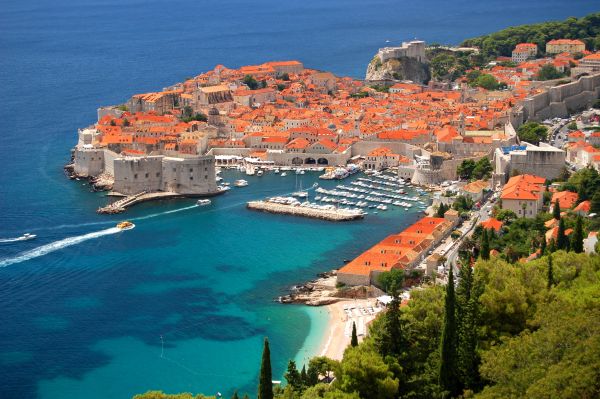
The Old Harbour at Dubrovnik's Old City, a UNESCO World Heritage Site.

Korana Canyon near Slunj, 30 km downriver from the Plitvice Lakes.

Main articles: Counties of Croatia

Croatia is divided into twenty-one counties (''županija'') and the capital Zagreb's city district (in italics below):
'Anglicized name' 'Native name'
1 Zagreb Zagrebačka
2 Krapina-Zagorje Krapinsko-zagorska
3 Sisak-Moslavina Sisačko-moslavačka
4 Karlovac Karlovačka
5 Varaždin Varaždinska
6 Koprivnica-Križevci Koprivničko-križevačka
7 Bjelovar-Bilogora Bjelovarsko-bilogorska
8 Primorje-Gorski Kotar Primorsko-goranska
9 Lika-Senj Ličko-senjska
10 Virovitica-Podravina Virovitičko-podravska
11 Požega-Slavonia Požeško-slavonska
12 Brod-Posavina Brodsko-posavska
13 Zadar Zadarska
14 Osijek-Baranja Osječko-baranjska
15 Šibenik-Knin Šibensko-kninska
16 Vukovar-Srijem Vukovarsko-srijemska
17 Split-Dalmatia Splitsko-dalmatinska
18 Istria Istarska
19 Dubrovnik-Neretva Dubrovačko-neretvanska
20 Međimurje Međimurska
21 City of Zagreb Grad Zagreb

Economy


Main articles: Economy of Croatia

The Croatian economy is post-communist. In the late 1980s, at the beginning of the process of economic transition, its position was favorable, but it was gravely impacted by de-industrialization, war destruction, as well as losing the markets of Yugoslavia and the SEV. The Croatian preliminary 2007 GDP data put Croatian GDP at USD 68,208 billion, or just over USD 15,355 per capita (real income), putting Croatia ahead of the EU member-states Romania, Bulgaria and Poland.
The economy is service-based, with the service sector accounting for 67% of the total GDP. The industrial sector is dominated by shipbuilding, followed by food processing and chemical industry. Industry makes up 27% of Croatia’s total economic output. Agriculture makes up 6%. Tourism is a notable source of income during the summer. With over 8.9 million foreign tourists in 2006 generating a revenue of EUR 7 billion, Croatia is ranked as the 18th most popular tourist destination in the world. In 2006 Croatia exported goods in value of USD 10.4 billion (FOB) (19.7 billion including service exports).
Unemployment was 11.9% in 2006. Of particular concern is the heavily backlogged judiciary system, combined with inefficient public administration, especially issues of land ownership and corruption.
The country has been preparing for membership in the European Union, its most important trading partner. In February 2005, the Stabilization and Association Agreement with the EU officially came into force.
In the first quarter of 2007, Croatian economy rose by 7.1% and annual growth rate which was expected to be around 4.8% has now been revised to 5.8-6.0%. Analysists believe that the Croatian economy, after modest growth of around 4.5% so far, is finally entering a period of faster and stronger economic prosperity.

Demographics


Zadar, St. Donatus' Church, a pre-Romanesque church from the ninth century

Main articles: Demographics of Croatia

The population of Croatia has been stagnating over the last decade. The 1991–1995 war in Croatia had previously displaced large parts of the population and increased emigration. Some Croats who fled the country during the war are returning. The natural growth rate is minute or negative (less than ± 1%), as the demographic transition has been completed half a century ago. Average life expectancy is approximately 75 years, and the literacy rate is 98.5%.
Croatia is inhabited mostly by Croats (89.9%). There are around twenty minorities, Serbs being the largest one (4.5%) and others having less than 0.5% each. The predominant religion is Catholicism (87.8%), with some Orthodox (4.4%) and Sunni Muslim (1.3%) minorities.
The official and common language, Croatian, is a South Slavic language, using the Latin alphabet. Less than 5% of the population cites other languages as their mother tongues.
There are large Croatian minorities in Bosnia-Herzegovina (571,317) , Argentina (440,000) , United States (374,241) , Germany (227,510) , Austria (131,307) , Chile (130,000) and many more.

Culture


Split, the largest city in Dalmatia.

Main articles: Culture of Croatia

Croatian culture is based on a thirteen century-long history during which the country has attained many monuments and cities, which gave birth to a number of historical figures. The country includes six World Heritage sites and eight national parks. Among a list of notable people that came from Croatia are three Nobel prize winners, and numerous inventors. Some of the world's first fountain pens came from Croatia.
Croatia also has a place in the history of clothing as the origin of the necktie (''cravat''). The country has a long artistic, literary and musical tradition. Of particular interest is the diverse nature of Croatian cuisine.

See also


Communications in Croatia

Holidays in Croatia

Military of Croatia

Protected areas of Croatia

Tourism in Croatia

Transport in Croatia

Sport in Croatia

Croatian War of Independence

List of Croatians

Law enforcement in Croatia

International rankings of Croatia

References


★ Agičić et al., ''Povijest i zemljopis Hrvatske, priručnik za hrvatske manjinske škole'' (''History and Geography of Croatia, a handbook for Croatian minority schools''), Biblioteka Geographica Croatica, 292 pages, Zagreb:2000 (ISBN 953-6235-40-4)

Notes


1. Jon Bowermaster, [http://www.nationalgeographic.com/adventure/0511/features/croatia.html Destination of the Year: Exploring the New Croatia}, ''National Geographic Adventure Magazine'', 2006. Retrieved, August 14, 2007.
2. http://www.sabor.hr/default.asp?jezik=2

Further reading


★ Ivo Banac, ''The National Question in Yugoslavia: Origins, History, Politics'' Cornell University Press, 1984.

★ Mirjana Kasapovic (ur.), ''Hrvatska politika 1990.-2000.'' Zagreb: Hrvatska politologija 2001.

★ Pavol Demes and Joerg Forbrig (eds.), ''Reclaiming Democracy: Civil Society and Electoral Change in Central and Eastern Europe.'' German Marshall Fund, 2007. ISBN 978-80-969639-0-4

★ Sharon Fisher, Political Change in Post-Communist Slovakia and Croatia: From Nationalist to Europeanist. New York: Palgrave Macmillan, 2006 ISBN 1 4039 7286 9

External links


Website of the Croatian Government

Basic facts, website of the Croatian Ministry of Foreign Affairs

Croatian National Tourist Board @ croatia.hr

General information about Croatia @ www.hr

Croatia - Overview of History, Culture, and Science

Croatia - Tourist information

Tourist attractions in Croatia

Croatia Directory

United Nations Development Programme: Croatia

Croatian World Network (Croatia.org)

State Institute for Nature Protection - Croatia

This article provided by Wikipedia. To edit the contents of this article, click here for original source.

psst.. try this: add to faves
Croatia Companies
Below is the list of travel companies in Croatia we have in our travel directory
''Republika Hrvatska''
Republic of Croatia
Common nameCroatia
Conventional long nameRepublic of Croatia
Image
Image
National anthem''Lijepa naša domovino''
''Our beautiful homeland''
Image
CapitalZagreb
Largest citycapital
DemonymCroat(s)
Croatian(s)
Official languagesCroatian
Government typeParliamentary republic
Government
PresidentStjepan Mesić
PremierIvo Sanader
Establishment
FoundedFirst half of 7th century
Medieval duchyMarch 4 852
IndependenceMay 21 879
Area
Area56,542
Area rank126th
Area magnitude1_E10
Percent water0.2
Population
Population estimate4,493,312
Population estimate year2007
Population estimate rank115th
Population census4,437,460
Population census year2001
Population density81
Population density rank109th
GDP
GDP PPP year2007
GDP PPP$68.21 billion (IMF)
GDP PPP rank68th
GDP PPP per capita$15,355 ( IMF)
GDP PPP per capita rank53rd
GDP nominal$47.42 billion (IMF)
GDP nominal year2007
GDP nominal per capita$10,676 (IMF)
HDI
HDI year2004
HDI0.846
HDI rank44th
HDI categoryhigh
Currency
Currencykuna
Currency codeHRK
Time zoneCET
Utc offset+1
Time zone DSTCEST
Utc offset DST+2
Internet TLD.hr
Calling code385
Footnote1Also Italian in Istria County and languages of other national minorities (Serbian, Hungarian, Czech, Slovak, etc.) in residential municipalities of the national minorities.