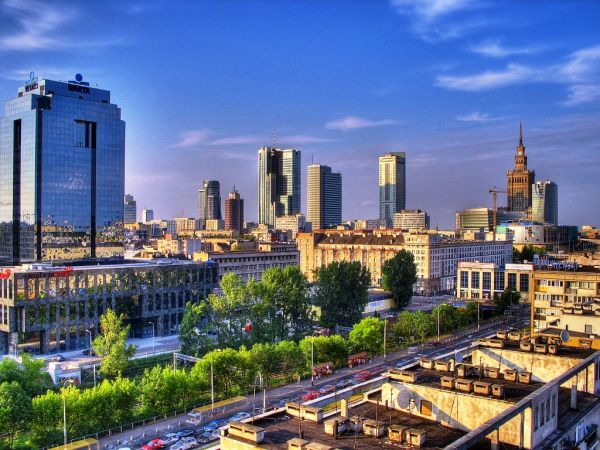
'Poland' (), officially the 'Republic of Poland' (), is a country in
Central Europe[2] bordered by
Germany to the west; the
Czech Republic and
Slovakia to the south;
Ukraine and
Belarus to the east; and the
Baltic Sea,
Lithuania and
Kaliningrad Oblast, a
Russian
exclave, to the north. The total
area of Poland is 312,679
km² (120,728
sq mi), making it the
69th largest country in the world. Poland's population is over 38.5 million people, concentrated mainly in large and medium cities.
The first Polish state was
baptized in 966, within territory very similar to the present boundaries of Poland. Poland became
a kingdom in 1025, and in 1569 it cemented a long
association with the
Grand Duchy of Lithuania by
uniting to form the
Polish-Lithuanian Commonwealth. The Commonwealth
collapsed in 1795. Poland
regained its independence in 1918 after
World War I but lost it again in
World War II, occupied by
Nazi Germany and the
Soviet Union, emerging several years later as a
communist country within the
Eastern Bloc under the control of the
Soviet Union. In 1989,
communist rule
was overthrown and Poland became what is informally known as the "Third Polish Republic". Poland is the 31st most populous country in the world. Poland is a
liberal democracy made up of sixteen
voivodeships (). Poland is also a member of
NATO, the
United Nations,
OECD and the
World Trade Organization.
Geography
Main articles: Geography of Poland
Poland’s territory extends across five geographical regions. In the northwest is the
Baltic seacoast, which extends from the
Bay of Pomerania to the
Gulf of Gdansk. This coast is marked by several
spits, coastal lakes (former bays that have been cut off from the sea), and dunes. The largely straight coastline is indented by the
Szczecin Lagoon, the
Bay of Puck, and the
Vistula Lagoon. The centre and parts of the north lie within the
Northern European Lowlands. Rising gently above these lowlands is a geographical region comprised of four hilly districts of
moraines and
moraine-dammed lakes formed during and after the
Pleistocene ice age. These lake districts are the Pomeranian Lake District, the Greater Polish Lake District, the Kashubian Lake District, and the
Masurian Lake District. The Masurian Lake District is the largest of the four and covers much of northeastern Poland. The lake districts form part of the Baltic Ridge, a series of moraine belts along the southern shore of the Baltic Sea. South of the Northern European Lowlands lie the regions of
Silesia and
Masovia, which are marked by broad ice-age river valleys. Farther south lies the Polish mountain region, including the
Sudetes, the Cracow-Częstochowa Upland, the
Świętokrzyskie Mountains, and the
Carpathian Mountains, including the
Beskids. The highest part of the Carpathians is the
Tatra Mountains, along Poland’s southern border.
The major historical regions of Poland include
Pomerania,
Greater Poland,
Silesia,
Lesser Poland,
Masovia,
Warmia,
Masuria, and
Podlachia.
Rivers
The longest rivers are the
Vistula, 1,047 km (678 miles) long; the
Oder—which forms part of Poland’s western border—854 km (531 miles) long; its tributary, the
Warta, 808 km (502 miles) long; and the
Bug —a tributary of the Vistula—772 km (480 miles) long. The Vistula and the Oder flow into the
Baltic Sea, as do numerous smaller rivers in Pomerania. The
Łyna and the
Angrapa flow by way of the
Pregolya to the Baltic, and the
Czarna Hańcza flows into the Baltic through the
Neman. While the great majority of Poland’s rivers drain into the Baltic Sea, Poland’s Beskids are the source of some of the upper tributaries of the
Orava, which flows via the
Váh and the
Danube to the
Black Sea. The eastern Beskids are also the source of some streams that drain through the
Dniester to the Black Sea.
Poland’s rivers have been used since early times for navigation. The
Vikings, for example, traveled up the Vistula and the Oder in their
longships. In the
Middle Ages and in early modern times, when
Poland-Lithuania was the breadbasket of Europe, the shipment of grain and other agricultural products down the Vistula toward
Gdańsk and onward to western Europe took on great importance. For an overview of the most important rivers in Poland, see the .
Geology
The geological structure of Poland has been shaped by the
continental collision of Europe and Africa over the past 60 million years, on the one hand, and the
Quaternary glaciations of northern Europe, on the other. Both processes shaped the Sudetes and the Carpathians. The moraine landscape of northern Poland contains soils made up mostly of
sand or
loam, while the ice-age river valleys of the south often contain
loess. The Cracow-Częstochowa Upland, the
Pieniny, and the
Western Tatras consist of
limestone, while the High Tatras, the Beskids, and the
Karkonosze are made up mainly of
granite and
basalts. The
Kraków-Częstochowa Upland is one of the oldest mountain ranges on earth.
Mountains and topography
Poland has 21 mountains of more than 2,000 metres (6,561 ft) in elevation, all in the
High Tatras. The Polish Tatras, which consist of the High Tatras and the
Western Tatras, is the highest mountain group of Poland and of the entire Carpathian range. In the High Tatras is Poland’s highest point, the northwestern peak of
Rysy, 2,499 metres (8, 199 ft) in elevation. At its foot lies the mountain lake, the
Morskie Oko. The second-highest mountain group in Poland is the
Beskids, whose highest peak is
Babia Góra, at 1,725 metres (5,659 ft). The next highest mountain group is the
Karkonosze, whose highest point is
Śnieżka, at 1,602 metres (5,256 ft). Among the most beautiful mountains of Poland are the
Bieszczady Mountains in the far southeast of Poland, whose highest point in Poland is Tarnica, with an elevation of 1,346 metres (4,416 ft). Tourists also frequent the Gorce Mountains in
Gorce National Park, with elevations around 1,300 metres (4,300 ft), and the
Pieniny in
Pieniny National Park, with elevations around 1,000 metres (3,300 ft). The lowest point in Poland—at 2 metres (7 ft) below sea level—is at Raczki Elbląskie, near
Elbląg in the Vistula Delta. For a list of the most important mountain ranges of Poland, see the .
Lakes

Rożnowskie Lake, near Rożnów in southeastern Poland
With almost 10,000 closed bodies of water covering more than one hectare (2.5 acres) each, Poland has one of the highest numbers of lakes in the world. In Europe, only
Finland has a greater density of lakes. The largest lakes, covering more than 100 square kilometers (386 square miles), are
Lake Śniardwy and
Lake Mamry in
Masuria, as well as
Lake Łebsko and
Lake Drawsko in
Pomerania. In addition to the lake districts in the north (in Masuria, Pomerania, Kashubia, Lubuskie, and
Greater Poland), there is also a large number of mountain lakes in the Tatras, of which the Morskie Oko is the largest in area. The lake with the greatest depth—of more than 100 metres (330 ft)—is
Lake Hańcza in the Wigry Lake District, east of Masuria in
Podlaskie Voivodship.
Among the first lakes whose shores were settled are those in the Greater Polish Lake District. The
stilt house settlement of
Biskupin, occupied by more than 1,000 residents, was founded before the 7th century BC by people of the
Lusatian culture. The ancestors of today’s Poles, the
Polanie, built their first fortresses on islands in these lakes. The legendary Prince
Popiel is supposed to have ruled from
Kruszwica on
Lake Gopło. The first historically documented ruler of Poland, Duke
Mieszko I, had his palace on an island in the Warta River in
Poznań.
For the most important lakes of Poland, see the .
The coast
The Polish Baltic coast is 528 kilometres (328 miles) long and extends from
Świnoujście on the islands of
Usedom and
Wolin in the west to
Krynica Morska on the
Vistula Spit in the east. For the most part, Poland has a smooth coastline, which has been shaped by the continual movement of sand by currents and winds from west to east. This continual
erosion and
deposition has formed cliffs, dunes, and spits, many of which have migrated landwards to close off former
lagoons, such as Łebsko Lake in Słowiński National Park. The largest spits are
Hel Peninsula and the Vistula Spit. The largest Polish Baltic island is Wolin. The largest port cities are
Gdynia,
Gdańsk,
Szczecin, and Świnoujście. The main coastal resorts are
Sopot,
Międzyzdroje,
Kołobrzeg,
Łeba,
Władysławowo, and the Hel Peninsula.
Land use
cover 28% of Poland’s land area. More than half of the land is devoted to agriculture. While the total area under cultivation is declining, the remaining farmland is more intensively cultivated. Livestock husbandry is especially widespread in the mountains.
More than 1% of Poland’s area—3,145 square kilometres (1,214 square miles)—is protected within 23
national parks. In this respect, Poland ranks first in Europe. Three more national parks are projected for Masuria, the Cracow-Częstochowa Upland, and the eastern Beskids. Most Polish national parks are located in the southern part of the country. In addition, wetlands along lakes and rivers in central Poland are legally protected, as are coastal areas in the north. There are also many areas designated as
landscape parks, and numerous
nature reserves.
Flora and fauna
Many animals that have since died out in other parts of Europe still survive in Poland, such as the
wisent in the
ancient woodland of the
Białowieża Forest and in
Podlachia. Other such species include the
brown bear in Białowieża, in the Tatras, and in the Beskids, the
gray wolf and the
Eurasian lynx in various forests, the
moose in northern Poland, and the
beaver in Masuria, Pomerania, and Podlachia. In the forests, one also encounters game animals, such as
red deer,
roe deer, and
boars. In eastern Poland there are a number of ancient woodlands, like Białowieża, that have never been cleared by people. There are also large forested areas in the mountains, Masuria, Pomerania, and
Lower Silesia.
Poland is the most important breeding ground for European migratory birds. Out of all of the migratory birds who come to Europe for the summer, one quarter breed in Poland, particularly in the lake districts and the wetlands along the
Biebrza, the
Narew, and the
Warta, which are part of nature reserves or national parks. In Masuria, there are villages in which storks outnumber people.
Climate
The climate is temperate. The climate is
oceanic in the north and west and becomes gradually more
continental as one moves south and east. Summers are generally warm, with average temperatures between 20 °C (68 °F) and 27 °C (80,6 °F). Winters are cold, with average temperatures around 3 °C (37,4 °F) in the northwest and –8 °C (17,6 °F) in the northeast. Precipitation falls throughout the year, although, especially in the east, winter is drier than summer.
Ethnicity and religion
In terms of ethnicity, Poland has been a homogeneous state since the end of
World War II. This is a major departure from much of Polish history. Due to the effects of the
Holocaust and the
flight and removal of German populations, Poland has become almost uniformly
Catholic. Catholics make up about 90% of the population (94.8% according to church
baptism statistics) with 46% as practising Catholics (according to opinion polls). Religious minorities include
Polish Orthodox (1.3% or about 509,500),
Jehovah’s Witnesses (0.3% or about 123,034),
Eastern Catholics (0.2%),
Lutherans (0.2%), and smaller minorities of
Mariavites,
Polish Catholics,
Pentecostals,
Seventh-Day Adventists,
Jews,
Muslims (including the Tatars of
Białystok) and various
Protestant (about 86,880 in the largest
Evangelical-Augsburg Church and about as many in smaller churches).
Poles (including
Silesians and
Kashubians) make up an overwhelming 99.3% majority of the Polish population. According to the 2002 census, the remainder of the population is made up of small minorities of
Germans (152,897),
Belarusians (c. 49,000), and
Ukrainians (c. 30,000), as well as
Tatars,
Lithuanians,
Roma,
Lemkos,
Russians,
Karaites,
Slovaks, and
Czechs. Among foreign citizens, the
Vietnamese are the largest ethnic group, followed by
Greeks, and
Armenians.
Poland, with 38.5 million inhabitants, has the eighth-largest population in Europe and the sixth-largest in the
European Union. It has a population density of 122 inhabitants per square kilometer (328 per square mile). The number of Poles living abroad is estimated at around 20 million.
History
Main articles: History of Poland
Prehistory
Main articles: Prehistory of Poland (until 966)
It was postulated that throughout
Late Antiquity, many distinct ethnic groups populated the regions of what is now known as Poland. The exact
ethnicity and
linguistic affiliation of these groups was hotly debated. Many
Slavic,
Celtic,
Baltic and
Germanic tribes were among the prominent groups. The politically charged discussion on the origins of the Slavs; historically two partially opposing views are held:
allochtonic or
autochtonic. The purely allochtonic view is historic and has no scholar defending it, many scholars now tend toward an autochtonic view, the most radical of which is the theory of Paleolithic continuity.
[3]
The most famous archeological find from the
Poland's prehistory is the
Biskupin fortified settlement, dating from the
Lusatian culture of the early
Iron Age, around 700 BC.
Piast dynasty
Main articles: History of Poland (966-1385)
Poland began to form into a recognizable unitary and territorial entity around the middle of the tenth century under the
Piast dynasty.
Poland's first historically documented ruler,
Mieszko I,
was baptized in 966, adopting
Catholic Christianity as the nation's new
official religion, to which the bulk of the population converted in the course of the next centuries. In the twelfth century, Poland
fragmented into several smaller states. In 1320,
Władysław I became the King of
a reunified Poland. His son,
Kazimierz III, is remembered as one of the greatest
Polish kings.
Poland was also a centre of migration of peoples and the
Jewish community began to settle and flourish in Poland during this era (see
History of the Jews in Poland). The
Black Death which affected most parts of Europe from 1347 to 1351 did not reach Poland.
[4]
Jagiellon dynasty
Main articles: History of Poland (1385-1569)
Under the
Jagiellon dynasty, Poland forged
an alliance with its neighbour, the
Grand Duchy of Lithuania.
Polish-Lithuanian Commonwealth
Main articles: History of Poland (1569-1795)
A
golden age ensued during the sixteenth century after the
Union of Lublin which gave birth to the
Polish-Lithuanian Commonwealth. The ''
szlachta'' (nobility) of Poland, far more numerous than in
Western European countries, took pride in
their freedoms and
parliamentary system. During the Golden Age period, Poland expanded its borders, to become the largest country in Europe.
In the mid-seventeenth century, a
Swedish invasion (
"The Deluge") and
Cossack's
Chmielnicki Uprising which ravaged the country marked the end of the golden age.
Numerous wars against Russia coupled with government inefficiency caused by the ''
Liberum Veto'', a right which had allowed any member of the parliament to dissolve it and to veto any legislation it had passed, marked the steady deterioration of the Commonwealth from a European power into a near-
anarchy controlled by its neighbours. The reforms, particularly those of the
Great Sejm, which passing of the
Constitution of May 3, 1791, second modern constitution of the world, were thwarted with the three
partitions of Poland (1772, 1793, and 1795) which ended with Poland's being erased from the map and its territories being divided between
Russia,
Prussia, and
Austria.

The Polish-Lithuanian Commonwealth at its greatest extent.
Partitions of Poland
Main articles: History of Poland (1795-1918)
Poles would resent their fate and
would several times rebel against the partitioners, particularly in the nineteenth century. In 1807
Napoleon recreated a Polish state, the
Duchy of Warsaw, but after the
Napoleonic wars, Poland was again divided in 1815 by the victorious Allies at the
Congress of Vienna. The eastern portion was ruled by the Russian
Czar as a
Congress Kingdom, and possessed
a liberal constitution. However, the Czars soon reduced Polish freedoms and Russia eventually ''de facto'' annexed the country. Later in the nineteenth century, Austrian-ruled
Galicia, particularly the
Free City of Kraków, became a center of Polish cultural life.
Reconstitution of Poland
Main articles: History of Poland (1918-1939)
During
World War I, all the
Allies agreed on the reconstitution of Poland that
United States President
Woodrow Wilson proclaimed in Point 13 of his
Fourteen Points. Shortly after the surrender of
Germany in November 1918, Poland regained its independence as the
Second Polish Republic (''II Rzeczpospolita Polska''). It reaffirmed its independence after
a series of military conflicts, the most notable being the
Polish-Soviet War (1919–1921) when
Poland inflicted a crushing defeat on the
Red Army.

Poland between 1922 and 1938.
The 1926
May Coup of
Józef Piłsudski turned the reins of the Second Polish Republic over to the
Sanacja movement.
World War II
Main articles: History of Poland (1939-1945)
The
Sanacja movement controlled Poland until the start of
World War II in 1939, when
Nazi Germany invaded on
September 1 and the
Soviet Union followed on
September 17.
Warsaw capitulated on
September 28 1939. As agreed in the
Ribbentrop-Molotov Pact, Poland was split into two zones,
one occupied by Germany while the eastern provinces fell under
the control of the Soviet Union.
Of all the countries involved in the war, Poland
lost the highest percentage of its citizens: over six million perished,
half of them Polish Jews. Poland made the fourth-largest troop contribution to the
Allied war effort, after the
Soviets, the
British and the
Americans. At the war's conclusion, Poland's borders
were shifted westwards, pushing the
eastern border to the
Curzon line. Meanwhile, the western border was moved to the
Oder-Neisse line. The new Poland emerged 20% smaller by 77,500 square kilometres (29,900
sq mi). The shift
forced the migration of millions of people, most of whom were
Poles,
Germans,
Ukrainians, and
Jews. Poland was where the main
Nazi death camps were. During the
Holocaust 3,000,000 out of 3,300,000
Jews were killed.
Postwar Communist Poland
Main articles: History of Poland (1945-1989)

At the end of World War II, the gray territories were transferred from Poland to the Soviet Union, and the pink territories from Germany to Poland.
The
Soviet Union instituted a new
Communist government in Poland, analogous to much of the rest of the
Eastern Bloc. Military alignment within the
Warsaw Pact throughout the
Cold War was also part of this change. The
People's Republic of Poland (''
Polska Rzeczpospolita Ludowa'')
was officially proclaimed in 1952. In 1956, the régime of
Władysław Gomułka became temporarily more liberal, freeing many people from prison and expanding some personal freedoms. Similar situation repeated itself in the 1970s under
Edward Gierek, but most of the time persecution of
communist opposition persisted.
Solidarity and the fall of communism
Main articles: History of Poland (1989-present)
Labour turmoil in 1980 led to the formation of the independent
trade union "
Solidarity" ("''Solidarność''"), which over time became a political force. It eroded the dominance of the
Communist Party and by 1989
had triumphed in parliamentary elections.
Lech Wałęsa, a Solidarity candidate, eventually
won the presidency in 1990. The Solidarity movement heralded the
collapse of communism across Eastern Europe.
Economic growth
A
shock therapy programme of
Leszek Balcerowicz during the early 1990s enabled the country to transform its economy into a robust
market economy. Despite temporary slumps in social and economic standards, Poland was the first post-communist country to reach its pre-1989
GDP levels. Most visibly, there were numerous improvements in other
human rights, such as
free speech. In 1991, Poland became a member of the
Visegrad Group and joined the
North Atlantic Treaty Organization (NATO) alliance in 1999 along with the
Czech Republic and
Hungary. Poles then voted to join the European Union in
a referendum in June 2003, with Poland becoming a full member on
May 1,
2004.
Politics
Main articles: Politics of Poland,
Foreign relations of Poland
Poland is a
liberal democracy, with a President as a
Head of State, whose current
constitution dates from 1997. The government structure centres on the
Council of Ministers, led by a
prime minister. The current prime minister is
Jarosław Kaczyński. The president appoints the
cabinet according to the proposals of the prime minister, typically from the majority coalition in the bicameral judicial lower house (the ''
Sejm''). The
president is elected by popular vote every five years. The current president is
Lech Kaczyński, the prime minister Jarosław Kaczyński's identical twin brother.
Polish voters elect a
bicameral parliament consisting of a 460-member lower house
Sejm and a 100-member Senate (''
Senat''). The ''
Sejm'' is elected under
proportional representation according to the
d'Hondt method, a method similar to that used in many parliamentary political systems. The Senate, on the other hand, is elected under a rare
plurality bloc voting method where several candidates with the highest support are elected from each
constituency. With the exception of ethnic minority parties, only candidates of
political parties receiving at least 5% of the total national vote can enter the ''Sejm''. When sitting in joint session, members of the ''Sejm'' and Senate form the
National Assembly (the ''Zgromadzenie Narodowe''). The National Assembly is formed on three occasions: when a new President takes the
oath of office; when an indictment against the President of the Republic is brought to the
State Tribunal (''Trybunał Stanu''); and when a President's permanent incapacity to exercise his duties due to the state of his health is declared. To date, only the first instance has occurred.
The
judicial branch plays an important role in decision-making. Its major institutions include the
Supreme Court of Poland (''Sąd Najwyższy''); the
Supreme Administrative Court of Poland (''Naczelny Sąd Administracyjny''); the
Constitutional Tribunal of Poland (''Trybunał Konstytucyjny''); and the
State Tribunal of Poland (''Trybunał Stanu''). On the approval of the Senate, the ''Sejm'' also appoints the
Ombudsman or the Commissioner for Civil Rights Protection (''Rzecznik Praw Obywatelskich'') for a five-year term. The Ombudsman has the duty of guarding the observance and implementation of the rights and liberties of Polish
citizens and
residents, of the law and of principles of community life and social justice.
Administrative divisions
Poland's provinces ("voivodeships") are largely based on the country's historic regions, whereas those of the past two decades (till 1998) had been centered on and named for individual cities. The new units range in area from under 10,000 km² (Opole Voivodeship) to over 35,000 km² (Masovian Voivodeship). Voivodeships are governed by voivod governments, and their legislatures are called
voivodeship sejmiks.
Poland is subdivided into sixteen
administrative regions known as
voivodeships (''województwa'', singular ''województwo''). In turn, the voivodeships are divided into ''
powiaty'' (singular ''powiat''), second-level units of
administration, equivalent to a
county,
district or
prefecture in other countries (
NUTS-4 or rather LAU-1) and then ''
gminy'' ("communes", singular ''gmina'').

Administrative map of Poland with
voivodeships marked in different colors.
Economy

Financial centre of
Warsaw, Poland's capital and largest city

The Trinitarian Tower and the Cathedral in
Lublin
Since the
fall of communism, Poland has steadfastly pursued a policy of
liberalising the economy and today stands out as a successful example of the transition from a
state-directed economy to a primarily
privately owned market economy.
The
privatisation of small and medium state-owned companies and a liberal law on establishing new firms have allowed the development of an aggressive private sector. As a consequence,
consumer rights organisations have also appeared. Restructuring and privatisation of "sensitive sectors" such as
coal,
steel,
railways, and energy has been continuing since 1990. Between 2007 and 2010, the government plans to float twenty public companies on the
Polish stock market, including parts of the coal industry. To date (2007), the biggest privatisations have been the sale of the national
telecoms firm ''
Telekomunikacja Polska'' to
France Telecom in 2000, and an issue of 30% of the shares in Poland's largest bank,
PKO Bank Polski, on the Polish stockmarket in 2004.
Poland has a large number of private farms in its
agricultural sector, with the potential to become a leading producer of food in the European Union. However, problems remain, especially under-investment. Structural reforms in
health care,
education, the
pension system, and
state administration have resulted in larger-than-expected fiscal pressures. Warsaw leads
Central Europe in foreign investment.
[6] GDP growth had been strong and steady from 1993 to 2000 with only a short slowdown from 2001 to 2002. The prospect of closer integration with the European Union has put the economy back on track, with growth of 3.7% annually in 2003, a rise from 1.4% annually in 2002. In 2004, GDP growth equaled 5.4%, in 2005 3.3% and in 2006 6.1%. For 2007, the government has set a target for GDP growth at 6.5 to 7.0%.
The long standing head of the
National Bank of Poland,
Leszek Balcerowicz, was replaced by
Sławomir Skrzypek in January 2007. At first the markets reacted sceptically and fell, but since then have stabilized and then risen sharply.
Recent annual growth rates by quarters have been:
| Year | Q1 | Q2 | Q3 | Q4 |
|---|
| 2007 | 7.4% | 6.7% | | |
|---|
| 2006 | 5.5% | 5.8% | 6.3% | 6.7% |
|---|
| 2005 | 2.1% | 2.8% | 3.7% | 4.3% |
|---|
| 2004 | 7.0% | 6.1% | 4.8% | 4.9% |
|---|
| 2003 | 2.2% | 3.8% | 4.7% | 4.7% |
|---|
Although the Polish economy is currently undergoing
economic development, there are many challenges ahead. The most notable task on the horizon is the preparation of the economy (through continuing deep structural reforms) to allow Poland to meet the strict economic criteria for entry into the
European Single Currency (Euro). There is much speculation as to just when Poland might be allowed to join the
Eurozone, though this will likely be sometime after 2012 or 2013.
[7] For now, Poland is preparing to make the Euro its official currency (though it has not joined the
ERM yet), and the
Złoty may eventually be replaced by Euro in the Polish economy.
Since joining the European Union, many Polish people have left their country to work in other EU countries (particularly Ireland and the UK) because of high unemployment, which is currently the second-highest in the EU with 10.5% in May 2007 (was 14.2% in May 2006).
[8]
Products Poland produces include clothes, glass, china (
Mikasa,
Waterford), electronics, cars (such as luxury
Leopard car), buses (
Autosan,
Jelcz SA,
Solaris,
Solbus), helicopters (
PZL Świdnik), transport equipment, locomotives, planes (
PZL Mielec), ships, military engineering (including
tanks,
SPAAG systems), medicines (
Polpharma,
Polfa), food, chemical products and others.
Science, technology and education
Education
The education of Polish society was a goal of rulers as early as the 12th century, and Poland soon came to the foremost of Europes most educated countries. The library catalogue of the Cathedral Chapter of
Kraków dating back to 1110 shows that already in the early 12th century Polish intellectuals had access to the European literature. In 1364, in
Kraków, the
Jagiellonian University, founded by King
Casimir III, became one of Europe's great early universities. In 1773 King
Stanisław August Poniatowski established his
Commission on National Education (''Komisja Edukacji Narodowej''), the world's first state ministry of education.
Current situation
Today, Poland has more than a hundred
tertiary education institutions; traditional
universities to be found in its major cities of
Białystok,
Bydgoszcz,
Gdańsk,
Katowice,
Kraków,
Lublin,
Łódź,
Olsztyn,
Opole,
Poznań,
Rzeszów,
Szczecin,
Toruń,
Warsaw,
Wrocław and
Zielona Góra as well as technical, medical, economic institutions elsewhere, employing around 61,000 workers. There are also around 300 research and development institutes, with about 10,000 more researchers. In total, there are around 91,000 scientists in Poland today.
According to a recent report by the
European Commission, Poland ranks 21st on the list of EU states in the area of
innovation. Conditions for knowledge creation are worsening, particularly because of a decline in business
research and development, from 0.28% of GDP in 1998 to 0.16% in 2003. Public R&D expenditures were 0.43% of GDP in 2003. The share of university R&D funded by the business sector has also declined, indicating that firms have not turned to outsourcing research to make up for declining R&D expenditures. Because of the very low levels of R&D, the process of transition of Poland to a
knowledge economy is slow.
Telecommunication and IT
The share of the
telecom sector in the GDP is 4.4% (end of 2000 figure), compared to 2.5% in 1996. Nevertheless, despite high expenditures for telecom infrastructure (the coverage increased from 78 users per 1000 inhabitants in 1989 to 282 in 2000)
the coverage mobile cellular is 850 users per 1000 people (2006)
★ Telephones—mobile cellular: 37.8 million (Raport Onet.pl and GUS, 2007)
★ Telephones—main lines in use: 12.5 million (Raport Telecom Team 2005)
Demographics
Poland
formerly played host to many languages, cultures, and religions. There was
a particularly significant Jewish life in Poland prior to the
Nazi Holocaust when Poland's
Jewish population, estimated at 3 million, was reduced to about 300,000 survivors. The outcomes of
World War II, particularly
the westwards shift of Poland's borders to the area between the
Curzon line and the
Oder-Neisse line coupled with
World War II evacuation and expulsion gave Poland an appearance of homogeneity.
Today 36,983,700 people, or 96.74% of the population considers itself
Polish (
Census 2002), 471,500 (1.23%) declared another nationality. 774,900 people (2.03%) didn't declare any nationality. Nathionalites or an ethnic groups in Poland are
Silesians,
Germans (most in the former
Opole Voivodeship),
Ukrainians,
Lithuanians,
Russians,
Jews and
Belarusians. The
Polish language, a member of the
West Slavic branch of the
Slavic languages, functions as the
official language of Poland. English and German are the most common second languages studied and spoken.
In recent years, Poland's population has decreased because of an increase in emigration and a sharp drop in the birth rate. In 2006, the census office estimated the total population of Poland at 38,536,869, a slight rise on the 2002 figure of 38,230,080. Since Poland's accession to the European Union, a significant number of Polish people have moved to work in Western European countries like the
United Kingdom and
Ireland. Some organisations state people have left primarily due to high
unemployment (10.5%) and better opportunities for work abroad. In April 2007, the Polish population of the
United Kingdom had risen to approximately 2 million, and estimates predict about 180,000 Polish people living in
Ireland.
A Polish minority is still present in neighbouring countries of Ukraine, Belarus, and Lithuania, as well as in other countries (see
Poles for population numbers). The largest number of
ethnic Poles outside of the country can be found in the
United States.
Urban Areas
The largest
metropolitan areas in Poland are the
Upper Silesian Coal Basin centred on
Katowice (3.5 million inhabitants); the capital,
Warsaw (3 million);
Łódź (1.3 million);
Kraków (1.3 million); the “Tricity” of
Gdańsk-
Sopot-
Gdynia in the Vistula delta (1.1 million);
Poznań (0.9 million);
Wrocław (0.9 million); and
Szczecin (0.9 million). For an overview of Polish cities, see
List of cities in Poland.
Culture
Polish culture has a rich thousand-year history influenced by both
West and
East. Today, these influences are evident in Polish
architecture,
folklore, and
art. Poland is the birthplace of many
world famous people, including
Pope John Paul II (),
Marie Skłodowska Curie (),
Kazimierz Pułaski (),
Nicolaus Copernicus () and
Frederic Chopin ().
The unique character of Polish art always reflected world trends. Famous Polish painter,
Jan Matejko included many significant historical events in his paintings. Also famous
person in history of Polish art was
Stanisław Ignacy Witkiewicz. He was an example of Polish ''Renaissance Man''.
Polish literature dates back to 1100s
[9] and includes many famous poets and writers such as
Jan Kochanowski,
Adam Mickiewicz,
Henryk Sienkiewicz (1905 Nobel Prize winner),
Bolesław Prus,
Władysław Reymont (1924 Nobel Prize winner),
Juliusz Słowacki,
Witold Gombrowicz,
Czesław Miłosz (1980 Nobel Prize winner),
Wisława Szymborska (1996 Nobel Prize winner),
Stanisław Lem,
Ryszard Kapuściński. Many world renowned
Polish movie directors include
Academy Awards winners
Roman Polański,
Andrzej Wajda,
Zbigniew Rybczyński,
Janusz Kamiński,
Krzysztof Kieślowski. The traditional Polish music composers include world famous pianist
Frederic Chopin ()
[10] as well as
Krzysztof Penderecki,
Karol Szymanowski, and others.
Famous modern singers, musicians and bands from Poland include
Behemoth,
Vader,
Decapitated,
SBB,
Riverside,
Edyta Górniak,
Lady Pank,
Anita Lipnicka and
Ich Troje.
Known meals from
Polish cuisine include
Polish sausage (),
red beet soup (),
duck blood soup (),
Polish dumplings (),
cabbage rolls (),
Polish pork chops (),
Polish traditional stew (), various
potato dishes, a fast food sandwich
zapiekanka, and many more. Traditional Polish desserts include
Polish doughnuts (),
Polish gingerbread () and others.
Sports
''see''
Sport in Poland
International rankings
See also
★
List of Poles
References
1. Mały Rocznik Statystyczny 2007 Central Statistical Office of Poland
2. Depending on the definition Poland can be considered part of both Central Europe and Eastern Europe. [1], [2]
3. Interdisciplinary and linguistic evidence for Palaeolithic continuity of
Indo-European, Uralic and Altaic populations in Eurasia, with an excursus on Slavic ethnogenesis by Mario Alinei url: http://www.continuitas.com/interdisciplinary.pdf
4. Teeple, J. B. (2002). ''Timelines of World History''. Publisher: DK Adult.
5. Other, rare deserts of Europe include Curonian Spit in Lithuania, [3] Deliblatska Peščara in Romania, [4], and Bardenas Reales in Spain. [5]
6. "Poland in the Lead," ''The Warsaw Voice'', September 2002. Retrieved August 11, 2007.
7. Jan Cienski, "Poland Alters Stance on Euro," in the ''Financial Times'', July 26, 2007. Retrieved August 11, 2007.
8. Eurostat May 2007 - Euro area and EU27 unemployment down to 7.0%, July 3, 2007
9. Polish Literature - The Middle Ages (Religious writings) Koca, B.
10. Towarzystwo im. Fryderyka Chopina Polskie Centrum Informacji Muzycznej: Związek Kompozytorów Polskich
External links
★
Poland at the World Factbook
★
Background Note: Poland
★
Poland.pl - Polish national portal
★