'Slovakia' (long form: 'Slovak Republic';
Slovak: ''Slovensko'', long form ''Slovenská republika'') is a
landlocked country in
Central Europe with a population of over five million and an area of about 49,000
square kilometres (almost 19,000
square miles). The Slovak Republic borders the
Czech Republic and
Austria to the west,
Poland to the north,
Ukraine to the east and
Hungary to the south. The largest city is its capital,
Bratislava. Slovakia is a member state of the
European Union,
NATO,
OECD,
WTO, and other international organizations.
The Slavic people arrived in the territory of present day Slovakia between the 5th and 6th century
AD during the
Migration Period (Migration of Nations). Various parts of Slovakia belonged to
Samo's Empire, the first known political unit of Slavs,
Great Moravia, the
Kingdom of Hungary,
Habsburg (Austrian) monarchy,
Austria-Hungary,
Czechoslovakia throughout history. Slovakia became independent on
1 January,
1993, after the
Velvet Divorce.
History
Main articles: History of Slovakia
Before the 5th century
From around 450 BC, the territory of modern-day Slovakia was settled by
Celts, who built powerful
oppida in
Bratislava and
Havránok.
Biatecs, the silver coins with the names of Celtic kings, represent the first known use of writing in Slovakia. From 6
AD, the expanding
Roman Empire established and maintained a chain of outposts around the
Danube. The Kingdom of
Vannius, a
barbarian kingdom founded by the
Germanic tribe of
Quadi, existed in western and central Slovakia from 20 to 50 AD.
Slavic states
The
Slavic population settled in the territory of Slovakia in the 5th century. Western Slovakia was the centre of
Samo's Empire in the 7th century. A Slovak state, known as the
Principality of Nitra, arose in the 8th century and its ruler
Pribina had the first
Christian church in Slovakia consecrated by 828. Together with neighboring
Moravia, the principality formed the core of the
Great Moravian Empire from 833. The high point of this Slovak empire came with the arrival of
Saints Cyril and Methodius in 863, during the reign of Prince
Rastislav, and the territorial expansion under King
Svätopluk.
Kingdom of Hungary
After the disintegration of the Great Moravian Empire in the early 10th century, the Magyars gradually annexed the territory of the present-day Slovakia. In the late 10th century, southwestern Slovakia became part of the arising Hungarian principality (after 1000 the
Kingdom of Hungary). Most of Slovakia was integrated into the Kingdom of Hungary by c. 1100, northeastern parts by c. 1300. Because of its high level of economic and cultural development, Slovakia retained its important position in this new state. For almost two centuries, it was ruled autonomously as the
Principality of Nitra, within the Kingdom of Hungary. Slovak settlements extended to northern and southeastern present-day Hungary, while Magyars started to settle down in the southern part of Slovakia. The ethnic composition became more diverse with the arrival of the
Carpathian Germans (from the 13th century),
Vlachs (from the 14th century), and
Jews.
A huge population loss resulted from the invasion of the
Mongols in 1241 and the subsequent famine. However medieval Slovakia was characterized rather by burgeoning towns, construction of numerous stone castles, and the development of art. In 1467,
Matthias Corvinus founded the first university in Bratislava, but the institution was short-lived.
After the
Ottoman Empire started its expansion into Hungary and the occupation of
Buda in the early 16th century, the center of the Kingdom of Hungary (under the name of
Royal Hungary) shifted towards Slovakia, and Bratislava (known as ''Pressburg'', ''Pozsony'', ''Pressporek'' or ''Posonium'' at that time) became the capital city of the
Royal Hungary in 1536. But the
Ottoman wars and frequent insurrections against the
Habsburg Monarchy also inflicted a great deal of destruction, especially in rural areas. As the Turks retreated from Hungary in the 18th century, Slovakia's importance within the kingdom decreased, although Bratislava retained its position of the capital city of Hungary until 1848, when the capital moved to
Budapest.
During the
revolution in 1848-49 the Slovaks supported the
Austrian Emperor with the ambition to secede from the Hungarian part of the Austrian monarchy, but they failed in the end to achieve this aim. During the period of the
Austro-Hungarian Empire, from 1867 to 1918, the Slovaks experienced severe oppression in the form of
Magyarisation promoted by the Hungarian government.
Twentieth century
In 1918, Slovakia joined the regions of
Bohemia and neighbouring
Moravia to form
Czechoslovakia (confirmed by the
Treaty of Saint Germain and
Treaty of Trianon). During the chaos following the breakup of Austria-Hungary, Slovakia was in 1919 attacked by the provisional
Hungarian Soviet Republic and 1/3 area of Slovakia temporarily became the
Slovak Soviet Republic.
During the Interwar period, democratic and prosperous Czechoslovakia was permanently threatened by the
revisionist governments of Germany and Hungary, until it was finally broken up in 1939, as a result of the
Munich Agreement concluded a year before. Southern Slovakia was lost to Hungary due to the
First Vienna Award.
Under pressure from
Nazi Germany, the
First Slovak Republic, led by a
clerical fascist leader
Jozef Tiso, declared its independence from Czechoslovakia in 1939. However, Tiso's government was strongly influenced by Germany and gradually became a
puppet regime. An anti-Nazi resistance movement launched a fierce armed insurrection, known as the
Slovak National Uprising, in 1944. A bloody German occupation and a guerrilla war followed. Most
Jews were deported from the country and murdered in German concentration camps during the
Holocaust. Jozef Tiso was hanged in 1947 for collaboration with Nazism.
After
World War II, Czechoslovakia was reconstituted and came under the influence of the
Soviet Union and its
Warsaw Pact from 1948 onward. In 1969, the state became a federation of the Czech Socialist Republic and the
Slovak Socialist Republic.
The end of Communist rule in Czechoslovakia in 1989, during the peaceful
Velvet Revolution, was followed once again by the country's dissolution, this time into two
successor states. Slovakia and the
Czech Republic went their separate ways after
January 1,
1993, an event sometimes called the
Velvet Divorce, but Slovakia has remained close partner with the Czech Republic, as well as with other Central European countries within the
Visegrad Group. Slovakia became a member of the
European Union in May 2004.
Geography
Main articles: Geography of Slovakia

Relief.

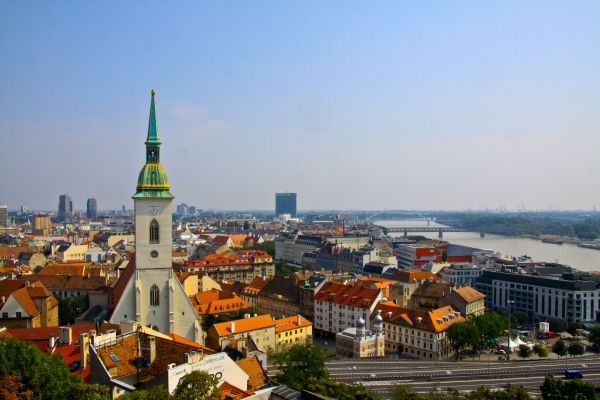
Bratislava Old Town.
The Slovak landscape is noted primarily for its mountainous nature, with the
Carpathian Mountains extending across most of the northern half of the country. Amongst these mountain ranges are the high peaks of the
Tatra mountains,
. To the north, close to the Polish border, are the
High Tatras which are a popular
skiing destination and home to many scenic lakes and valleys as well as the highest point in Slovakia, the
Gerlachovský štít at 2,655 metres (8,711 ft).
Major Slovak rivers, besides the
Danube, are the
Váh and the
Hron.
The Slovak climate lies between the temperate and continental climatic zones, with relatively warm summers and cold, cloudy and humid winters. The area of Slovakia can be divided into three kinds of climatic zones and the first zone can be divided into two subzones.
'A Climate of lowlands'
'A.a Climate of lowlands with dominance of oceanic influences'
- average annual temperature is about 9-10 °C. The average temperature of the hottest month is about 20 °C and the average temperature of the coldest month is greater than -3 °C. This kind of climate occurs at Záhorská nížina and Podunajská nížina. It is the typical climate of the capital city Bratislava
[1].
'A.b Climate of lowlands with dominance of continental influences'
- average annual temperature is about 8-9 °C. The average temperature of the hottest month is about 19 °C and the average temperature of the coldest month is less than -3 °C. This kind of climate can be found at Košická kotlina and Východoslovenská nížina. It is the typical climate of the town of Košice
[2].
'B Climate of basins'
- average annual temperature is between 5 °C and 8,5 °C. The average temperature of the hottest month is between 15 °C and 18,5 °C and the average temperature of the coldest month is between -3 °C and -6 °C. This climate can be found in almost all basins in Slovakia. For example Podtatranská kotlina, Žilinská kotlina, Turčianska kotlina, Zvolenské kotlina. It is the typical climate for the towns of Poprad
[3] and Sliač
[4].
'C Mountain climate'
- average annual temperature is less than 5 °C. The average temperature of the hottest month is less then 15 °C and the average temperature of the coldest month is less than -5 °C. This kind of climate occurs in mountains and in some villages in the valleys of Orava and Spiš.
Demographics
Main articles: Demographics of Slovakia
The majority of the inhabitants of Slovakia are ethnically
Slovak (86%).
Hungarians are the largest ethnic minority (9.5%) and are concentrated in the southern regions of the country.
[ Slovakia ]
Other ethnic groups include
Roma with 1.8%,
Czechs with 0.8%,
Ruthenians with 0.4%,
Ukrainians with 0.2% and
Germans with 0.1%. The estimated percentage of Roma ranges from 1.8% (self-identification of the Roma in the last census) to around 5.6% (based on interviews with municipality representatives and mayors, that is based on the ascription by the remaining population). Note however that in the case of the 5.6%, the above percentages of Hungarians and Slovaks are lower by 4 percentage points in sum.
The official state language is
Slovak, a member of the
Slavic languages, but
Hungarian is also widely spoken in the south of the country and enjoys a co-official status in some municipalities.
The
Slovak constitution guarantees
freedom of religion. The majority of Slovak citizens (68.9 %) identify themselves with
Roman Catholicism (although church attendance is lower); the second-largest group are people without confession (13%). About 6.93% belong to
Lutheranism, 4.1% are
Greek Catholic,
Calvinism has 2.0%, other and non-registered churches 1.1% and some 0.9% are
Eastern Orthodox. It is estimated that there are about 5,000
Muslims in Slovakia. About 2,300
Jews remain of the large estimated pre-WWII population of 90,000.
[1]
In 2004 Slovakia had a
fertility rate of 1.25 (i.e., the average woman will have 1.25 children in her lifetime), which is one of the lowest numbers among EU countries. The fertility rate is currently increasing again.
Politics
Main articles: Politics of Slovakia
Slovakia is a parliamentary democratic republic with a multi-party system. The last
parliamentary elections were held on
June 17,
2006 and two rounds of
presidential elections took place on
April 3,
2004 and
April 17,
2004.
The Slovak
head of state is the president (
Ivan Gašparovič, 2004 - 2009), elected by direct popular vote for a five-year term. Most
executive power lies with the
head of government, the prime minister (
Robert Fico, 2006 - 2010), who is usually the leader of the winning party, but he/she needs to form a majority
coalition in the parliament. The prime minister is appointed by the president. The remainder of the
cabinet is appointed by the president on the recommendation of the prime minister.
Slovakia's highest
legislative body is the 150-seat
unicameral National Council of the Slovak Republic (''Národná rada Slovenskej republiky''). Delegates are elected for a four-year term on the basis of
proportional representation. Slovakia's highest
judicial body is the Constitutional Court (''Ústavný súd''), which rules on
constitutional issues. The 13 members of this court are appointed by the president from a slate of candidates nominated by parliament.
Slovakia is a member state of the
European Union since
May 1,
2004 and of
NATO since
March 29,
2004. As a member of the
United Nations (since 1993), Slovakia was, on
October 10,
2005, for the first time elected to a two-year term on the
UN Security Council (for 2006-2007). Slovakia is also a member of
WTO,
OECD,
OSCE, and other international organizations.
Regions and districts
Main articles: Regions of Slovakia,
Districts of Slovakia
As for administrative division, Slovakia is subdivided into 8 ''
kraje'' (singular - ''kraj'', usually translated as regions, but actually meaning rather county), each of which is named after its principal city. Regions enjoy a certain degree of autonomy since 2002. Their self-governing bodies are referred to as Self-governing (or autonomous) Regions (sg. ''samosprávny kraj'', pl. ''samosprávne kraje'') or Upper-Tier Territorial Units (sg. ''vyšší územný celok'', pl. ''vyššie územné celky'', abbr. VÚC).
#
Bratislava Region (''Bratislavský kraj'') (capital
Bratislava)
#
Trnava Region (''Trnavský kraj'') (capital
Trnava)
#
Trenčín Region (''Trenčiansky kraj'') (capital
Trenčín)
#
Nitra Region (''Nitriansky kraj'') (capital
Nitra)
#
Žilina Region (''Žilinský kraj'') (capital
Žilina)
#
Banská Bystrica Region (''Banskobystrický kraj'') (capital
Banská Bystrica)
#
Prešov Region (''Prešovský kraj'') (capital
Prešov)
#
Košice Region (''Košický kraj'') (capital
Košice)
(the word ''kraj'' can be replaced by ''samosprávny kraj'' or by ''VÚC'' in each case)
The "kraje" are subdivided into many ''
okresy'' (sg. ''okres'', usually translated as districts). Slovakia currently has 79 districts.
In terms of
economics and
unemployment rate, the western regions are richer than eastern regions; however the relative difference is no bigger than in most EU countries having regional differences.
Economy
Main articles: Economy of Slovakia
Slovakia has pursued a difficult transition from a centrally planned economy to a modern market economy. Major
privatizations are nearly complete, the
banking sector is almost completely in foreign hands, and foreign investment has picked up.
Solid domestic demand boosted
economic growth to 4.1% in 2002. Strong export growth, in turn, pushed economic growth to a still-strong 4.2% in 2003 and 5.4% in 2004, despite a downturn in household consumption. Multiple reasons entailed a GDP growth of 6% in 2005, the 4th highest rate in the
EU (after the three Baltic states). GDP growth is expected to reach 8.2% in 2006 (the year-to-year growth amounted to unexpected 9.8% in the 3th quarter of 2006 and stayed high at 9.5% year-to-year change in the 4th quarter of 2006), and 8.0% in 2007. The 9.8% growth came as a surprise to local analysts (6 % was expected), given that the big foreign investor Kia was only going to launch its production in late 2006. In 2006, Slovakia reached the highest economic growth among the members of
OECD.
Unemployment, peaking at 19.2% at the end of 2001, decreased again to some 8.9% (March 2007).
[2] In addition to the economic growth, migration of workers to other member-states of the European Union also contributed to this reduction. The unemployment rate still remains among the highest in the EU.
Inflation dropped from an average annual rate of 12.0% in 2000 to just 3.3% in the election year 2002, but it rose again in 2003-2004 because of increases in taxes and regulated prices. It reached 3.7 % in 2005.
Slovakia plans to adopt the
Euro currency on
1 January 2009 and has already entered the
ERM II for this purpose (
Slovak euro coins).
Slovakia is among the most attractive countries in the EU for foreign investors mainly because of its low labour costs (a 2005 survey by the prominent consultant firm
Deloitte shows that Slovakia has the lowest labour costs in the European Union) and low tax rates. This issue has sparked criticism from some other EU countries, which accuse Slovak government of social and tax
dumping. In recent years, Slovakia has been pursuing a policy of encouraging foreign investment. However, that has not shown any benefits so far in innovation capabilities within the country.
Despite a sufficient number of researchers and a solid secondary educational system, Slovakia (as well as some other post-communist countries) still faces many challenges in the field of modern
knowledge economy. The business and public
Research and development expenditures are deeply below EU average.
Tourism
Main articles: Tourism in Slovakia
Slovakia features interesting natural landscapes, mountains, deep
caves, medieval
castles and towns, folk architecture, spas and
ski resorts.
International rankings
Human Development Index 2006: Rank 42nd out of 177 countries
Index of Economic Freedom 2006: Rank 34th out of 157 countries
Reporters Without Borders world-wide press freedom index 2006: Rank 8th out of 168 countries
Global Competitiveness Report ranking 2006-2007: Rank 37th out of 125 countries.
See also
Culture
★
Cinema of Slovakia
★
Music of Slovakia
★
Slovak literature
★
Slovak language
★
Slovak cuisine
★
Slovak national weapon
Holidays
★
National holidays in Slovakia
★
Remembrance days in Slovakia
Miscellaneous topics
★
Communications in Slovakia
★
Education in Slovakia
★
Foreign relations of Slovakia
★
History of ice hockey in Slovakia
★
List of villages and municipalities in Slovakia
★
List of rivers in Slovakia
★
List of rulers of Slovakia
★
List of Slovaks
★
List of tourism regions of Slovakia
★
List of towns in Slovakia
★
List of traditional regions of Slovakia
★
Military of Slovakia
★
Protected areas of Slovakia
★
Transportation in Slovakia
References
1. Deportations
2. Statistical Office of the Slovak Republic
Further reading
★ Pavel Dvorak: ''The Early History of Slovakia in Images'' ISBN 80-85501-34-1
★ Julius Bartl and Dusan Skvarna: ''Slovak History: Chronology & Lexicon'' ISBN 086-5164444
★ Olga Drobna, Eduard Drobny and Magdalena Gocnikova: ''Slovakia: The Heart of Europe'' ISBN 086-5163197
★ Karen Henderson: ''Slovakia: The Escape from Invisibility'' ISBN 0415274362
★ Stanislav Kirschbaum: ''A History of Slovakia : The Struggle for Survival'' ISBN 0312161255
★ Alfred Horn: ''Insight Guide: Czech & Slovak Republics'' ISBN 088-7296556
★ Rob Humphreys: ''The Rough Guide to the Czech and Slovak Republics'' ISBN 1858289041
★ Michael Jacobs: ''Blue Guide: Czech and Slovak Republics'' ISBN 0393319326
★ Neil Wilson, Richard Nebesky: ''Lonely Planet World Guide: Czech & Slovak Republics'' ISBN 1864502126
★ Eugen Lazistan, Fedor Mikovic, Ivan Kucma and Anna Jureckova: ''Slovakia: A Photographic Odyssey'' ISBN 086-5165173
★ Lil Junas: ''My Slovakia: An American's View'' ISBN 8070906227
External links
★
The Slovak Republic Government Office
★
The official travel guide to Slovakia
★
Slovakia Tourism from The Slovak Tourist Board
★
Slovakia.org - guide to Slovakia
★
Slovak Republic Guide
★
CIA World Factbook - Slovakia
★
Statistical Office of the Slovak Republic
★
Historical photos of Slovakia
★
Google satellite map of Slovakia
★
The Slovak Spectator, English-speaking news magazine