Map of Romania with Transylvania and Partium in yellow
'Transylvania' ( or ''Transilvania''; ; ; ; / ''Transilvanija'' or Ердељ / ''Erdelj'') is a
historical region in central and western
Romania.
In its early history, the territory of present-day Transylvania belonged to
Dacia, the
Roman Empire, the
Hun Empire and the
Gepid Kingdom
[1]. As a political entity, Transylvania is mentioned from the 11th century (after the Hungarian conquest) as a
voivodship, part of the
Kingdom of Hungary. It then successively became an autonomous
principality under
Ottoman suzerainty in 1571, a part of the
Habsburg Monarchy in 1711 (
Austria-Hungary after 1867), and a part of the
Kingdom of Romania after
World War I.
Transylvania's main city,
Cluj-Napoca, is considered to be the region's historical capital, although Transylvania was also ruled from
Alba Iulia during its
vassalage to the Ottoman Empire, and the seat of the
Transylvanian Diet was moved to
Sibiu for some time in the 19th century.
Etymology
Main articles: Historical names of Transylvania
Transylvania was first referred to in a
Medieval Latin document in 1075 as ''Ultra silvam'', meaning "beyond the forest" (''ultra'' meaning "beyond, on the other side" and the
accusative case of ''sylva'' (sylvam) meaning "wood or forest"). That name was later changed to "Transylvania" (''trans'' also meaning "across, over, beyond").
The German name ''Siebenbürgen'' means "seven fortresses", after the seven (
ethnic German)
Transylvanian Saxons' cities in the region (
Kronstadt,
Schäßburg,
Mediasch,
Hermannstadt,
Mühlbach,
Bistritz and
Klausenburg). The Hungarian name ''Erdély'' is derived from ''Erdő-elve'' meaning ''"beyond the forest"'' in Hungarian (a meaning first referred to in its Medieval Latin version in a 12th century document - ''
Gesta Hungarorum'').
The origin of the
Romanian name ''Ardeal'' is controversial. ''Ardeal'' - as ''Ardeliu'' - was first referred to in a document in
1432. It may be a borrowing from the
Khazar “Ardil-land” (Hebrew „Eretz Ardil”, „ארדיל”), first mentioned in
960. It could be likewise borrowed from the Celtic "Arduenna" (forest), reflected in other names such as
Arda,
Ardal,
Ardistan,
Ardiche,
Ardennes,
Ardelt,
Ardilla or from the Sunskrit ''Har-Deal''. Lastly, it may be a borrowing of the
Hungarian name ''Erdély'', as is the
Romani name ''Ardyalo'' - in old Hungarian, ''Erdély'' was pronounced as ''Erdél''. The initial
Hungarian ''e-'' occasionally changes to ''a'' in Romanian (cf. Hung. ''egres'' "gooseberry" and ''Egyed'', which became ''agriş'' and ''
Adjud'' in
Romanian). See also
other languages.
Geography and ethnography

Romanian ethnographic regions (Transylvania-red; Maramureş-blue; Sǎtmar-green; Crişana-yellow; Banat-purple)

Hungarian ethnographic regions (King's Pass - yellow; Western Transylvania - green; Eastern Transylvania - blue)
The Transylvanian plateau, 300 to 500 metres (1,000-1,600 feet) high, is drained by the
Mureş,
Someş,
Criş, and
Olt rivers, as well as other tributaries of the
Danube. This core of historical Transylvania roughly corresponds with nine counties of modern Romania. Other areas to the west and north, which also united with Romania in 1918 (inside the border established by peace treaties in 1919-20), are since that time widely considered part of Transylvania.
★ Transylvania proper:
★
★
Amlaş
★
★
Ţara Bârsei
★
★
Chioar
★
★
Ciceu
★
★
Făgăraş
★
★
Haţeg
★
★
Mărginimea Sibiului
★
★
Câmpia Transilvaniei
★
★
Ţara Moţilor
★
★
Nösnerland
★
★
Székely Land
★
Banat
★
Crişana
★
★
Ţara Zarandului
★
Maramureş
★
★
Ţara Lǎpuşului
★
★
Ţara Oaşului
''See also
Administrative divisions of the Kingdom of Hungary''. In common reference, the Western border of Transylvania has come to be identified with the present Romanian-
Hungarian border, settled in the Treaty of Trianon, although geographically the two are not identical.
Administrative divisions
The historical region covers 16 present-day
counties (
Romanian: ''
judeţ'') which include nearly 103 600 km² of central and northwest Romania. The 16 counties are:
★
Alba
★
Arad
★
Bihor
★
Bistriţa-Năsăud
★
Braşov
★
Caraş-Severin
★
Cluj
★
Covasna
★
Harghita
★
Hunedoara
★
Maramureş
★
Mureş
★
Sălaj
★
Satu Mare
★
Sibiu
★
Timiş
The most populous cities are:
★
Cluj-Napoca (318,027)
★
Timişoara (317,651)
★
Braşov (283,901)
★
Oradea (206,527)
★
Arad (172,824)
★
Sibiu (155,045)
★
Târgu Mureş (149,577)
★
Baia Mare (137,976)
★
Satu Mare (115,630)
Economy
Transylvania is rich in mineral resources, notably
lignite,
iron,
lead,
manganese,
gold,
copper,
natural gas,
salt, and
sulfur.
There are large iron and
steel, chemical, and
textile industries. Stock raising,
agriculture,
wine production, and fruit growing are important occupations.
Timber is another valuable resource.
Transylvania accounts for around 35% of Romania's GDP, and has a GDP per capita (PPP) of around $11,500, around 10% higher than the Romanian average.
Population
According to the 2002 census, Transylvania has a population of 7,221,733, with a large Romanian majority (74.69%). In addition, there are also sizeable
Hungarian (19.60%),
Roma (3.39%),
German (0.73%) and
Serb (0.1%) communities.
[2] [3] Fourteen of the 16 counties have Romanian majorities, and two (
Covasna and
Harghita) are mostly Hungarian.
The percentage of Romanians has increased since the union of Transylvania with Romania (
1918). This is due to three processes: emigration of minority populations (1,000,000 Germans, Hungarians and Jews have left the country since WWII), assimilation, and internal migration within Romania (estimates show that between 1945 and 1977, some 630,000 people have moved from the
Regat to Transylvania, and 250,000 from Transylvania to the Regat, most notably to
Bucharest).
[4] The assimilation process slowed down during the first stages of the communist era (see
Hungarian Autonomous Province) and then accelerated under
the Ceauşescu regime.
History
Main articles: History of Transylvania
Ancient History: Dacia and the Roman Empire
The kingdom of
Dacia was in existence at least as early as the beginning of the 2nd century BC and it reached its maximum extent under
Burebista. The area now constituting Transylvania was the political center of
Dacia where several important fortified cities, among them
Sarmizegetusa, near today's
Hunedoara were built.
In 101-102 and 105-106,
Trajan, the
Roman emperor, fought a military campaign against the Dacians, known as the
Dacian Wars. He managed to vanquish them and after the suicide of
Decebalus parts of Dacia were incorporated into the Roman province
Dacia Trajana. The Romans built mines, access roads and forts to protect them. Colonists from other Roman provinces were brought in to settle the land and cities like ''Apulum'' (now
Alba Iulia) and ''Napoca'' (now
Cluj-Napoca) appeared. The Dacians rebelled frequently and due to increasing pressure from them and the
Visigoths in 271, the Emperor
Aurelian abandoned Dacia Trajana.
The Middle Ages
The former Dacia Trajana province was controlled by the Visigoths and
Carpians until they were in turn displaced and subdued by the
Huns in 376, under the leadership of
Attila. After the disintegration of Attila's empire, the rules of Gepids of
Avars succeeded. The region was also influenced during this period by massive
Slavic migration. At the beginning of the 9th century, Transylvania, along with eastern
Pannonia, was incorporated into the
First Bulgarian Empire followed by
Magyar tribes linking it to the
Principality of Hungary.
The Kingdom of Hungary
The early 11th century was marked by the conflict between
King Stephen I of Hungary and his maternal uncle
Gyula, the ruler of Transylvania. After the defeat of the latter, Transylvania became part of the Kingdom of Hungary. The Transylvanian
Roman Catholic bishopric and the
comitatus system were organised. By the 12th century the
Szeklers were established in eastern and southeastern Transylvania as border guards and in the 12th and 13th centuries, the areas in the south and northeast were settled by
German colonists called
Transylvanian Saxons. In 1241-1242, during the
Mongol invasion, Transylvania was devastated and a large portion of the population perished. In
1285, there was another Mongol invasion in Transylvania, led by
Nogai Khan.
Transylvania was organized according to the system of
Estates, which were privileged groups (''universitates'') with power and influence in socio-economic and political life, being nonetheless organized according to certain ethnic criteria as well. The first Estate was the lay and ecclesiastic aristocracy, ethnically heterogeneous, but undergoing a process of homogenization around its Hungarian nucleus. The other Estates were Saxons, Szeklers and Romanians (or
Vlachs - ''
Universitas Valachorum''), all with an ethnic and ethno-linguistic basis (''Universis nobilibus, Saxonibus, Syculis et Olachis''). The general assembly (''congregatio generalis'') of the four Estates had mainly supra-legislative powers in Transylvania, but it sometimes took measures regarding order in the country, relationships between the privileged, military issues, etc.
After the
Decree of Turda (1366), which openly called for "''to expel or to exterminate in this country malefactors belonging to any nation, especially Romanians''" in Transylvania, the only possibility for Romanians to retain or access nobility was through
conversion to Roman Catholicism. Some
Orthodox Romanian nobles converted, being integrated in the Hungarian nobility, but the most of them declined, thus losing their status and privileges.
In some border regions (
Maramureş,
Ţara Haţegului) the Orthodox Romanian ruling class of ''
nobilis kenezius'' (classed as lower nobility in the Kingdom as a whole) had the same rights as the Hungarian ''nobilis conditionarius''. Nevertheless, because of the gradual loss of a nobility of its own, Romanians were no longer able to keep their ''Universitas Valachorum''.
After the suppression of the
Budai Nagy Antal-revolt in 1437, the political system was based on ''
Unio Trium Nationum'' (''The Union of the Three Nations''). According to the Union, which was explicitly directed against
serfs and other peasants, society was ruled by three
privileged
Estates or nations (''Nationes''), the
nobility (mostly
Magyars), the Szekelys, and the Saxon
burghers.
A key figure to emerge in Transylvania in the first half of the 15th century was
John Hunyadi. His subsequent military exploits against the
Ottoman Empire brought him further status as the
governor of Hungary in 1446 and
papal recognition as the
Prince of Transylvania in 1448. John Hunyadi was also the father of
Matthias Corvinus of Hungary.
Independent principality
The 16th century was marked by the struggle between the
Ottoman Empire and the
Habsburg Empire. After
Sultan Suleiman I overran central Hungary and established there the Turkish rule (see
Ottoman Hungary), Transylvania became a semi-independent region where Austrian and Turkish influences vied for supremacy for nearly two centuries.
Due to the fact that Transylvania was now beyond the reach of
Catholic religious authority,
Protestant preaching such as
Lutheranism and
Calvinism were able to flourish. In 1568 the Edict of
Turda proclaimed four religious expressions -
Catholic,
Lutheranism,
Calvinism and
Unitarianism - as "accepted" (''receptae''), while
Orthodoxy, which was the confession of the Romanian population, was proclaimed as "tolerated" (''tolerata''). The Edict of Turda is considered by mostly Hungarian historians as the first legal guarantee of religious freedom in Christian Europe.
The Báthory family came to power in 1571 and ruled Transylvania as princes under the Ottomans, and briefly under
Habsburg suzerainty, until 1600. The latter period of their rule saw a four-sided conflict in Transylvania involving the Transylvanians, the
Austrians, the Ottomans, and the Wallachian
voivod Michael the Brave. The latter gained control of Transylvania in 1599 after the
Battle of Şelimbăr and succeeded in uniting the three principalities of
Wallachia,
Moldavia and Transylvania (the three main parts of present-day
Romania). The union did not last long, however, as Michael was assassinated by mercenaries under the command of the Habsburg general
Giorgio Basta in August 1601. Basta swore allegiance to the Habsburg Emperor,
Rudolph II and by 1604 reclaimed the principality for Catholicism through the
Counter Reformation.
The
Calvinist magnate of
Bihar county Stephen Bocskai managed to obtain, through the Peace of
Vienna (
June 23,
1606), religious liberty and political autonomy, the restoration of all confiscated estates, the repeal of all "unrighteous" judgments, and a complete retroactive amnesty for all Hungarians in
Royal Hungary, as well as his own recognition as independent sovereign prince of an enlarged Transylvania. Under Bocskai's successors Transylvania passed through a period of flourishment both for the religious movements and for the arts and culture. It was one of the few European countries where
Roman Catholics,
Calvinists,
Lutherans, and
Unitarians lived in mutual tolerance, but
Orthodox Romanians were denied equal rights.
Habsburg Empire
After the defeat of the Ottomans at the
Battle of Vienna in 1683, the Habsburgs gradually began to impose their rule on the formerly autonomous Transylvania. Apart from strengthening the central government and administration, the Habsburgs also promoted the Roman Catholic Church, both as a uniting force and also as an instrument to reduce the influence of the Protestant nobility. In addition, they tried to persuade Romanian Orthodox clergymen to join the
Greek (Byzantine Rite) Catholic Church in union with Rome. As a response to this policy, several peaceful movements of the Romanian Orthodox population advocated for freedom of worship for all the Transylvanian population, most notably being the movements led by Visarion Sarai, Nicolae Oprea Miclăuş and
Sofronie of Cioara.
From 1711 onward, the princes of Transylvania were replaced with Austrian governors and in 1765 Transylvania was declared a grand principality.
The
revolutionary year 1848 was marked by a great struggle between the Hungarians, the Romanians and the Habsburg Empire. Warfare erupted in November with both Romanian and Saxon troops, under Austrian command, battling the Hungarians led by the Polish general
Józef Bem. He carried out a sweeping offensive through Transylvania, and
Avram Iancu managed to retreat to the harsh terrain of the
Apuseni Mountains, mounting a
guerrilla campaign on Bem's forces. After the intervention by the armies of Tsar
Nicholas I of Russia, Bem's army was defeated decisively at the Battle of Temesvár (
Timişoara) on
9 August 1849.
Having quashed the revolution, Austria imposed a repressive regime on Hungary, ruled Transylvania directly through a military governor and granted citizenship to the Romanians. However, in the
Ausgleich of 1867, which established the
Austro-Hungarian Empire, the special status of Transylvania ended and it was reincorporated into the
Kingdom of Hungary. The new unity of Austria-Hungary created a process of
Magyarization affecting Transylvania's Romanians and German Saxons.
Austria-Hungary
The 300-year long separate status of Transylvania came to an end after the
Compromise from 1867. On 20 June 1867, the
Diet was dissolved by royal decree, and an ordinance abrogated the legislative acts of the
Sibiu provincial assembly. The department of the interior inherited the responsibilities of the
Transylvanian Gubernium, and the government reserved the right to name Transylvania's royal magistrates as well the Saxon bailiff of the Universitas Saxorum. Hungarian legislation also came to supersede the Austrian code of civil procedure, penal law, commercial law, and regulations for bills of exchange.
Romania
Since the
Austro-Hungarian empire had begun to disintegrate after the end of the
First World War, the nationalities living inside proclaimed their independence from the empire. The 1228-member National Assembly of Romanians of Transylvania and Hungary, headed by leaders of Transylvania's
Romanian National Party and
Social Democratic Party, passed a resolution calling for unification of all Romanians in a single state on
1 December in
Alba Iulia. This was approved by the National Council of the Germans from Transylvania and the Council of the
Danube Swabians from the
Banat, on
15 December in
Mediaş. In response, the Hungarian General Assembly of
Cluj reaffirmed the loyalty of Hungarians from Transylvania to Hungary on
December 22, 1918. (''See also:
Union of Transylvania with Romania'')
The
Treaty of Versailles placed Transylvania under the sovereignty of Romania, an ally of the
Triple Entente, and after the defeat in 1919 of
Béla Kun's
Hungarian Soviet Republic by the Romanian army, the Treaties of
St. Germain (1919) and
Trianon (signed in June 1920) further elaborated the status of Transylvania and defined the new border between the states of Hungary and Romania. King
Ferdinand I of Romania and Queen
Maria of Romania were crowned at Alba Iulia in 1922 as King of all Romania.
In August 1940, the second
Vienna Award gave the northern half of Transylvania to
Hungary but after the
Treaty of Paris (1947) at the end of the
Second World War the territory was returned to
Romania. The post-WWII borders with
Hungary, agreed on at the Treaty of Paris were identical with those set out in 1920.
Historical coat of arms of Transylvania
Main articles: Coat of arms of Transylvania
The
Diet of 1659 codified the representation of the privileged nations in Transylvania's
coat of arms. It depicts:
★ A black
turul on a blue background, representing the medieval nobility, which was primarily
Magyar.
★ The
Sun and the
Moon representing the
Székelys.
★ Seven red towers on a yellow background representing the seven fortified cities of the
Transylvanian Saxons
(The red dividing band was originally not part of the coat of arms.)
Tourist attractions
★ The
medieval cities of
Alba Iulia,
Cluj-Napoca,
Sibiu (European Capital Of Culture-2007) , and
Sighişoara
★ The city of
Braşov and the nearby
Poiana Braşov ski resort
★ The city of
Hunedoara with the 14th century
Hunyadi Castle
★ The citadel and the
Sezession city centre of
Oradea
★ The
Wooden Churches of the
Maramureş region
★
The Saxon fortified churches
★ The
Székely Land - mountains,
spas,
mofette,
Hungarian traditions and folk culture
★ The
Dacian Fortresses of the Orăştie Mountains, including
Sarmizegetusa
★ The
cafe culture [3],
street theatre and
cosmopolitan society of
Sibiu
Culture
''For people connected to Transylvania's cultural life, see:
List of Transylvanians.''
Transylvania in fiction
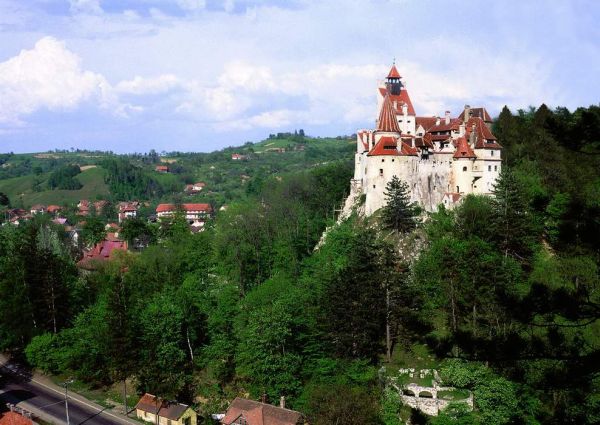
In the Western world, Transylvania is famously the home of
Count Dracula from
Bram Stoker's
Dracula.
References
★
1. History of Transylvania Béla Köpeczi (editor)
2. 2002 Census official results:[1]
3. ''Ethnocultural Diversity Resource Centre'' database:[2]
4. Varga, E. Árpád, ''Hungarians in Transylvania between 1870 and 1995'', Translation by Tamás Sályi, Budapest, March 1999 , p. 27.
Further reading
★ Patrick Leigh Fermor, ''Between The Woods And The Water'' (New York Review of Books Classics, 2005; ISBN 1-59017-166-7). Fermor travelled across Transylvania in the summer of 1934, and wrote about it in this account first published more than 50 years later, in 1986.
★ Zoltán Farkas and Judit Sós,
Transylvania Guidebook
External links
★
Hungarian Human Rights Foundation — Human Rights group dedicated to preserving the rights of Transylvania's Hungarians
★
''Tolerant Transylvania - Why Transylvania will not become another Kosovo'', Katherine Lovatt, in Central Europe Review, Vol 1, No 14 27 September 1999.
★
''The History Of Transylvania And The Transylvanian Saxons'' by Dr. Konrad Gündisch, Oldenburg, Germany
★
Transylvanian Webcatalogue
★
''Historical Literature about Transilvania and Neighbouring Territories'' by Klaus Popa, Germany
★
''Transylvania, its Products and its People, by Charles Boner, 1865''
★
Transylvanian Family History Database