

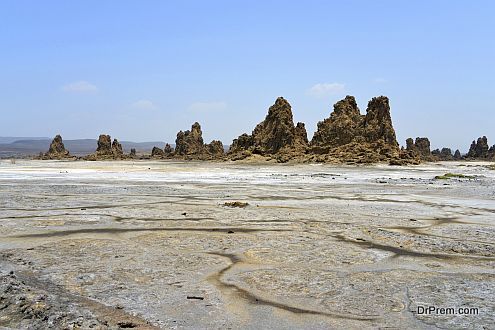
A 'lake' (from Latin ''lacus'') is a body of water or other liquid of considerable size contained on a body of land. A vast majority of lakes on Earth are
fresh water, and most lie in the
Northern Hemisphere at higher
latitudes. In
ecology the environment of a lake is referred to as 'lacustrine'. Large lakes are occasionally referred to as "inland
seas" and small seas are occasionally referred to as lakes. Smaller lakes tend to put the word "lake" after the name, as in
Green Lake, while larger lakes often invert the word order, as in
Lake Ontario, at least in North America. In some places, the word "lake" does not correctly appear in the name at all (eg
Windermere in
Cumbria).
Most lakes have a natural outflow in the form of a
river or stream, but some do not, and lose water solely by evaporation and/or underground seepage. They are termed
endorheic lakes (see below).
The term 'lake' is also used to describe a feature such as
Lake Eyre, which is a dry basin most of the time but may become filled under seasonal conditions of heavy rainfall.
Many lakes are artificial and are constructed for
hydro-electric power supply,
recreational purposes,
industrial use,
agricultural use, or domestic water supply.
Evidence of extra-terrestrial lakes exists; "definitive evidence of lakes filled with methane" was announced by NASA as returned by the
Cassini Probe observing the moon
Titan, which orbits the planet
Saturn.
Origin of natural lakes
Geologically speaking, most lakes are young. The natural results of
erosion will tend to wear away one of the basin sides containing the lake, such as the shores of
Lake Baikal in Russia which is estimated to be 25 – 30 million years old. There are a number of natural processes that can form lakes. A recent
tectonic uplift of a mountain range can create bowl-shaped depressions that accumulate water and form lakes. The advance and retreat of glaciers can scrape depressions in the surface where lakes accumulate; such lakes are common in
Scandinavia,
Patagonia,
Siberia and
Canada. Lakes can also form by means of landslides or by glacial blockages. An example of the latter occurred during the last ice age in the US state of
Washington, when a huge lake formed behind a glacial flow; when the ice retreated, the result was an immense flood that created the
Dry Falls at
Sun Lakes,
Washington.
Salt lakes (also called
saline lakes) can form where there is no natural outlet or where the water evaporates rapidly, and the drainage surface of the
water table has a higher than normal
salt content. Examples of salt lakes include
Great Salt Lake, the
Caspian Sea, the
Aral Sea and the
Dead Sea.
Small, crescent-shaped lakes called
oxbow lakes can form in river valleys as the result of meandering. The slow-moving river forms a sinuous shape as the outer side of bends are eroded away more rapidly than the inner side. Eventually a horseshoe bend is formed and the river cuts through the narrow neck. This new passage then forms the main passage for the river and the ends of the bend become silted up, thus forming a bow-shaped lake.
Lake Vostok is a
subglacial lake in
Antarctica, possibly the largest in the world. The pressure from ice and the internal chemical composition means that if the lake were drilled into, it may result in a fissure which would spray in a similar fashion to a
geyser.
Some lakes, such as
Lake Baikal and
Lake Tanganyika lie along continental
rift zones, and are created by the crust's
subsidence as two plates are pulled apart. These lakes are the oldest and deepest in the world, and may be destined over millions of years to become oceans. The
Red Sea is thought to have originated as a
rift valley lake.
Crater Lake in
Oregon, USA is a lake located within the
caldera of
Mount Mazama. The caldera was created in a massive volcanic eruption that lead to the subsidence of Mount Mazama around 4860 BC. Since that time, all eruptions on Mazama have been confined to the caldera.
Some lakes, such as
Lake Jackson, USA come into existence as a result of
sinkhole activity.
Types of lakes

One of the many artificial lakes in
Arizona at sunset.
★ '
Periglacial': Part of the lake's margin is formed by an
ice sheet,
ice cap or
glacier, the ice having obstructed the natural
drainage of the land.
★ '
Subglacial': A lake which is permanently covered by
ice. They can occur under glaciers and ice caps or ice sheets. There are many such lakes, but
Lake Vostok in
Antarctica is by far the largest. They are kept
liquid because the overlying ice acts as a
thermal insulator retaining energy introduced to its underside by
friction, water percolating through crevasses, by the pressure from the
mass of the ice sheet above or by
geothermal heating below.
★ 'Artificial', also called a
reservoir: A lake created by
flooding land behind a
dam, by human excavation, or by the flooding of an
open pit mine (sometimes called a quarry). Some of the world's largest lakes are reservoirs.
Husain Sagar is a reservoir in India built in 1562.
★ '
Endorheic', also called 'terminal' or 'closed': A lake which has no significant outflow, either through rivers, or underground diffusion. Any water within an endorheic basin leaves the system only through
evaporation. These lakes are most common in desert locations, such as
Lake Eyre in central
Australia or the
Aral Sea in central Asia.
★ '
Meromictic': A lake which has layers of water which do not intermix. The deepest layer of water in such a lake does not contain any dissolved oxygen. The layers of sediment at the bottom of a meromictic lake remain relatively undisturbed because there are no living organisms to stir them up.
★ '
Fjord lake': A lake in a glacially eroded valley, which has been eroded below sea level.
★ '
Oxbow': A lake which is formed when a wide meander from a stream or a river is cut off to form a lake. They are called oxbow lakes due to the distinctive curved shape that results from this process.
★ 'Rift lakes': A lake which forms as a result of subsidence along a geological fault in the Earth's
tectonic plates. Examples include the
Rift Valley lakes of eastern
Africa and
Lake Baikal in
Siberia.
★ '
Underground': A lake which is formed under the surface of the Earth's crust. Such a lake may be associated with
caves and
aquifers and
springs.
★ '
Crater': A lake which forms in volcanic
calderas or craters after the volcano has been inactive for some time. Water in these types of lakes may be
fresh, or highly
acidic, and may contain various dissolved
minerals. Some also have
geothermal activity, especially if the volcano is merely dormant rather than extinct.
★ '
Lava': A pool of molten lava contained in a volcanic crater or other depression. Lava lakes that have partly or completely solidified are also referred to as lava lakes.
★ '': A lake which is no longer in existence. Such lakes include
prehistoric lakes, and lakes which have permanently dried up through
evaporation or human intervention.
Owens Lake in
California, USA is an example of a former lake. Former lakes are a common feature of the
Basin and Range area of south-western North America.
★ '': Closely related to ''former'' lakes, a shrunken lake is one which has drastically decreased in size over geological time.
Lake Agassiz is a good example of a shrunken lake, which covered much of central North America. Some notable remnants of this lake are
Lake Winnipeg and
Lake Winnipegosis.
Characteristics
Lakes have numerous features in addition to lake ''type'', such as ''(but not limited to)''
drainage basin (also known as catchment area), inflow, and outflow,
nutrient content,
dissolved oxygen,
pollutants,
pH, and
sedimentation.
The change in level of a lake is controlled by the difference between the sources of inflow and outflow, compared to the total volume of the lake. The significant input sources are precipitation onto the lake; runoff carried by streams and channels from the lake's
catchment area;
groundwater channels and aquifers; and artificial sources from outside the catchment area. Output sources are evaporation from the lake; surface and groundwater flows; and any extraction of lake water by humans. As climate conditions and human water requirements vary, these will create fluctuations in the lake level.
Lakes can be also categorized on the basis of their richness of nutrients, which typically affects plant growth. Nutrient-poor lakes are said to be '''
oligotrophic''' and are generally clear, having a low concentration of plant life. '''
Mesotrophic''' lakes have good clarity and an average level of nutrients. '''
Eutrophic''' lakes are enriched with nutrients, resulting in good plant growth and possible
algal blooms. And '''
hypertrophic''' lakes are bodies of water that have been excessively enriched with nutrients. These lakes typically have poor clarity and are subject to devastating algal blooms. Lakes typically reach this condition due to human activities, such as heavy use of fertilizers in the lake catchment area. Such lakes are of little use to humans, and have a poor ecosystem due to decreased dissolved oxygen.
Due to the unusual relationship between
water's
temperature and its
density, lakes form layers called
thermoclines which are layers of drastically varying temperature relative to depth. Fresh water is most dense at about 4 degrees
Celsius (39.2 °F) at sea level. When the temperature of the water at the surface of a lake reaches the same temperature as deeper water (such as during the cooler months in
temperate climates), the water in the lake can mix, bringing oxygen starved water up from the depths, and bringing oxygen down to decomposing sediments. Deep temperate lakes can maintain a reservoir of cold water year-round which allows some cities to tap that reservoir for
deep lake water cooling.
Since the surface water of deep
tropical lakes never reaches the temperature where water reaches its maximum density, there is no process that makes the water mix. The deeper layer becomes oxygen starved, and can become saturated with carbon dioxide, or other gases such as sulfur dioxide if there is even a trace of
volcanic activity. Exceptional events, such as earthquakes or landslides, can cause mixing which rapidly brings up the deep layers, and can release a vast cloud of toxic gases which lay trapped at the bottom of the lake. An example of such a release is
Lake Nyos in
Cameroon. The amount of gas that can be dissolved in water is directly related to pressure. As the previously deep water surfaces, the pressure drops, and a vast amount of gas comes out of solution. Under these circumstances even carbon dioxide is toxic because it is heavier than air and displaces oxygen, so it may flow down the river valley to human or livestock settlements and cause mass
asphyxiation.
The material at the bottom of a lake or ''lake bed'' may be composed of a wide variety of materials, including
inorganics such as
silt or
sand sediments, and
organic material such as decaying plant or animal matter. The composition of the lake bed has a significant impact on the flora and fauna found within the lake's environs by contributing to the amounts and the types of nutrients available.
Limnology
Limnology is the study of inland bodies of water and related ecosystems, and divides lakes in three zones:
littoral zone, which is a sloped area that is close to land;
photic or open-water zone, where sunlight is abundant; and deep-water
profundal or
benthic zone, where little sunlight can reach. The depth which light can reach in lakes depends on the density and motion of
particles. These particles can be
sedimentary or
biological in origin and are responsible for the color of the water. Decaying plant matter, for instance, may be responsible for a yellow or brown color, while algae may result in greenish water. In very shallow water bodies, iron oxides make water reddish brown. Biological particles are
algae and
detritus. A sediment particle is in
suspension if its weight is less than the random
turbidity forces acting upon it. The turbidity is a decisive factor in the transparency of the water. Bottom-dwelling detritivorous
fish are responsible for turbid waters, because they stir the mud in search for food.
Piscivorous fish eat plant-eating (
planktonivorous) fish, thus increasing the amount of algae (see aquatic
trophic cascade). The light depth or transparency is measured by using a
Secchi disk. This is a 20 cm (8 in) disk with alternating white and black
quadrants. The depth at which the disk is no longer visible, is the Secchi depth, and is a measure for transparency. It is commonly used to test
eutrophication. For a detailed look at these processes, see
lentic system ecology.
A lake moderates the surrounding region's
temperature and
climate because
water has a very high
specific heat capacity (4,186 J·kg
−1·K
−1). In the daytime, the lake can cool the land beside it with
local winds, resulting in a
sea breeze; in the night, it can warm it, forming a
land breeze.
How lakes disappear

Lake Chad in a 2001 satellite image, with the actual lake in blue, and vegetation on top of the old lake bed in green. Above that, the changes from 1973 to 1997 are shown.
A lake may be infilled with deposited sediment, and gradually, the lake becomes a
wetland, such as a
swamp or
marsh. An important difference exists between lowland and highland lakes: lowland lakes are more placid, are less rocky/more sedimentary, have a less sloping bottom, and generally contain more plant life. Large water plants (typically
reeds) accelerate this closing process significantly because they partially decompose to form peat soils that fill shallows of lakes. Conversely a peat soils in a marsh can naturally burn and reverse this process to recreate a shallow lake. Turbid lakes, and lakes with much plant-eating fish, tend to disappear slower. A "disappearing" lake (barely noticeable on a human timescale) typically has a water's edge with extensive plant mats. They become a new habitat for other plants (like
peat moss, when conditions are right) and animals, many of which are very rare. Gradually, the lake closes, and young
peat may form, forming a
fen. In lowland river valleys (allowing the river to
meander), the presence of peat is explained by the closing of historical
oxbow lakes. In the very last stages of
succession, more
trees would grow in, eventually turning the wetland into a
forest.
Some lakes can also disappear seasonally; they are called
intermittent lakes and are typical of
karstic terrain. A prime example of this is
Lake Cerknica in
Slovenia. On
3 June,
2005 in
Nizhny Novgorod Oblast,
Russia, a lake called
Lake Beloye vanished in a short period of time (minutes). News sources reported government officials theorized that this strange phenomena may have been caused by a shift on soil underneath the lake which drained water to channels leading to Oka River.
[1]
The presence of ground permafrost is also important to lake persistence. According to research published in the journal Science ("Disappearing Arctic Lakes," June 2005), thawing permafrost may explain the shrinking or disappearance of hundreds of large Arctic lakes across western Siberia. The idea here is that rising air and soil temperatures thaw permafrost, allowing the lakes to drain away into the ground.
Neusiedler See, located in
Austria and
Hungary, dried up several times for a number years during the past centuries.
As of 2005, it is again rapidly losing water, giving rise to the fear that it will be completely dried up by
2010.
Some lakes disappear because of human development factors. The shrinking
Aral Sea is described as being "murdered" by the intended diversion of rivers feeding the lake for irrigation.
Extraterrestrial lakes
At present the surface of the planet
Mars is too cold and has too little
atmospheric pressure to permit pooling of liquid water on the surface. However geologic evidence appears to confirm that ancient lakes once formed on the surface. It is also possible that volcanic activity on Mars will occasionally melt the subsurface ice, forming large lakes. Under current conditions this water will quickly evaporate or freeze unless insulated in some manner, such as by a coating of volcanic ash.
Jupiter's small moon
Io is volcanically active due to tidal stresses, and as a result
sulfur deposits have accumulated on the surface. Some photographs taken during the
Galileo mission appear to show lakes of liquid sulfur on the surface.
There are dark basaltic plains on the
Moon, similar to
lunar maria but smaller, that are called ''lacus'' (singular ''lacus'',
Latin for "lake"). They were once thought by early astronomers to be literal lakes.
On
July 24,
2006 photos brought in by the
Cassini-Huygens spacecraft give a strong evidence for the existence of
methane or
ethane lakes on
Titan.
Notable lakes
★ The 'largest' lake in the world by surface area is the
Caspian Sea. With a surface area of 394,299 km², it has a surface area greater than the next six largest lakes combined.
★ The 'deepest' lake is
Lake Baikal in
Siberia, with a bottom at 1,637 m (5,371 ft.) and is the world's largest freshwater lake by volume.
★ The world's 'oldest' lake is
Lake Baikal, followed by
Lake Tanganyika (
Tanzania).
★ The world's 'highest' lake is an unnamed pool on
Ojos del Salado at ,
[2] the
Lhagba Pool in
Tibet at comes second.
[3]
★ The world's 'highest' commercially navigable lake is
Lake Titicaca in
Peru and
Bolivia at . It is also the largest freshwater (and second largest overall) lake in
South America.
★ The world's 'lowest' lake is the
Dead Sea bordering
Israel,
Jordan and
the West Bank at 418 m (1,371 ft) below sea level. It is also one of the lakes with highest
salt concentration.
★ The largest freshwater lake by surface area, and third largest by volume, is
Lake Superior with a surface area of 82,414 km². However,
Lake Huron and
Lake Michigan form a single hydrological system with surface area 117,350 km², sometimes designated
Lake Michigan-Huron. All these are part of the
Great Lakes of
North America.
★ The largest
island in a freshwater lake is
Manitoulin Island in
Lake Huron, with a surface area of 2,766 km².
Lake Manitou, located on Manitoulin Island, is the largest lake on an island in a freshwater lake.
★ The largest lake located on an island is
Nettilling Lake on
Baffin Island.
★ The largest lake in the world that drains naturally in two directions is
Wollaston Lake.
★
Lake Toba on the island of
Sumatra is located in what is probably the largest resurgent
caldera on
Earth.
★ The largest lake located completely within the boundaries of a single city is
Lake Wanapitei in the city of
Greater Sudbury, Ontario,
Canada. Before the current city boundaries came into effect in 2001, this status was held by
Lake Ramsey, also in Sudbury.
★
Lake Enriquillo in
Dominican Republic is the only saltwater lake in the world inhabited by
crocodiles.
Largest by continent
The largest lakes (surface area) by
continent are:
★ 'Africa' -
Lake Victoria, also the second largest freshwater lake on
Earth. It is one of the
Great Lakes of Africa.
★ 'Antarctica' -
Lake Vostok (subglacial)
★ 'Asia' -
Caspian Sea, also the largest on Earth.
★ 'Australia' -
Lake Eyre
★ 'Europe' -
Lake Ladoga, followed by
Lake Onega, both located in northwestern
Russia.
★ 'North America' -
Lake Superior
★ 'South America' -
Lake Titicaca, which is also the highest navigable body of water on Earth at 3821 m above sea level.
'Note':
Lake Maracaibo can be considered as the largest lake in South America. It however lies at sea level with a relatively wide opening to sea, so it is better described as a bay.
Trivia
★
Finland is known as ''The Land of the Thousand Lakes'' (actually there are 187,888 lakes in Finland, of which 60,000 are large)
[4].
★ The
U.S. state of
Minnesota is known as ''The Land of Ten Thousand Lakes''.
★ The license plate of the
Canadian province of
Manitoba used to claim "100,000 lakes" as one-upmanship on Minnesota.
★ The
Great Lakes of
North America originated in the
ice age.
★ Only one lake in the English
Lake District is actually a lake; other than
Bassenthwaite Lake, the others are all "meres" or "waters".
★ Over 60% of the world's lakes are in
Canada; this is because of the
deranged drainage system that dominates the country.
★ Only six bodies of water in
Scotland are known as lakes (the others are
lochs): the
Lake of Menteith, the
Lake of the Hirsel,
Pressmennan Lake, Cally Lake near
Gatehouse of Fleet, the saltwater Manxman's Lake at
Kirkcudbright Bay and The Lake at Fochabers. Of these only the Lake of Menteith and Cally Lake are natural bodies of fresh water.
See also
★
List of lakes
★
List of world's largest lakes
★
List of largest lakes of Western Europe
★
List of world's deepest lakes
★
Loch
★
Lough
★
Pond
★
Limnology
★
Lagoon
★
Liman
★
Mere (lake)
★
Geography
★
Tarn
★
Deep lake water cooling
★
Angling
★
Lake monster
References
1. http://www.mtstandard.com/articles/2005/06/04/newsnationworld/hjjejdjghhjejd.txt
2. http://www.andes.org.uk/peak-info-6000/ojos-info.htm
3. http://www.highestlake.com/
4. Statistics Finland
External links
★
Lakes Database
★
Lake Classification Systems
★
UKLakes Database
★
Midwest Lakes Policy Center
★
Kashmir lakes
★
Ponds and Lakes : definitions
★
Some interesting Islands and Lakes