

(Redirected from Mediterranean)
:''"Med" redirects here. For other uses, see
MED.''

Composite
satellite image of the Mediterranean Sea.
The 'Mediterranean Sea' is a
sea of the
Atlantic Ocean almost completely enclosed by land: on the north by
Europe, on the south by
Africa, and on the east by
Asia. It covers an approximate area of
2.5 million km² (965,000
sq mi), but its connection to the Atlantic (the
Strait of Gibraltar) is only 14 km (9 mi) wide. In
oceanography, it is sometimes called the 'Eurafrican Mediterranean Sea' or the 'European Mediterranean Sea' to distinguish it from mediterranean seas elsewhere.
It was the most important route for merchants and travelers of ancient times, allowing for trade and cultural exchange between emergent peoples of the region — the
Mesopotamian,
Egyptian,
Semitic,
Persian,
Phoenician,
Carthaginian,
Greek,
Levantine, and
Roman cultures. The
history of the Mediterranean is crucial to understanding the origins and development of many modern societies.
Name
The term ''Mediterranean'' derives from the
Latin ''mediterraneus'', "inland" (''medius'', "middle" + ''terra'', "land, earth"). To the ancient Romans, the Mediterranean was the center of the earth as they knew it.
The Mediterranean Sea has been known by a number of alternative names throughout human history. It was, for example, commonly called ''
Mare Nostrum'' (Latin, "Our Sea") and occasionally ''Mare Internum'' by the Romans (
Sallust, ''Jug.'' 17). The
Greeks name it ''Mesogeios'' (Μεσόγειος), meaning "inland, interior"
(μεσο, "middle" + γαιος, "land, earth")
[1]. In the
Old Testament, on the west coast of the
Holy Land, and therefore behind a person facing the east, it is called the "Hinder Sea", sometimes translated as "Western Sea", (
Deut. 11:24;
Joel 2:20), and also the "Sea of the Philistines" (
Exod. 22:81), because that people occupied a large portion of its shores near the
Israelites. Mostly, however, it was the "Great Sea" (
Num. 34:6,7;
Josh. 1:4, 9:1, 15:47;
Ezek. 47:10,15,20), or simply "The Sea" (
1 Kings 5:9; ''comp.''
1 Macc. 14:34, 15:11). In
Hebrew, it is called ''HaYam HaTikhon'' (הַיָּם הַתִּיכוֹן), "the middle sea", a literal adaptation of the German equivalent ''Mittelmeer''. In
Turkish, it is ''Akdeniz'', "the white sea". In Arabic, it is ''Al-Baħr Al-Abyad Al-Muttawasit'' (البحر الأبيض المتوسط), "the middle white sea".
History
Main articles: History of the Mediterranean region
As a sea around which some of the most ancient human civilizations were arranged, it has had a major influence on the history and ways of life of these cultures. It provided a way of trade, colonization and war, and was the basis of life (via fishing and the gathering of other seafood) for numerous communities throughout the ages.
The combination of similar shared climate, geology and access to a common sea has led to numerous historical and cultural connections between the ancient and modern societies around the Mediterranean.
Geography and climate

Map of the Mediterranean Sea.
The Mediterranean Sea is connected to the
Atlantic Ocean by the
Strait of Gibraltar on the west and to the
Sea of Marmara and the
Black Sea, by the
Dardanelles and the
Bosporus respectively, on the east. The Sea of Marmara is often considered a part of the Mediterranean Sea, whereas the Black Sea is generally not. The man-made
Suez Canal in the southeast connects the Mediterranean Sea to the
Red Sea.
Large
islands in the Mediterranean include
Cyprus,
Crete,
Euboea,
Rhodes,
Lesbos,
Chios,
Kefalonia and
Corfu in the eastern Mediterranean;
Sardinia,
Corsica,
Sicily, and
Malta in the central Mediterranean; and
Ibiza,
Majorca and
Minorca (the
Balearic Islands) in the western Mediterranean.
The
Mediterranean climate is generally one of wet winters and hot, dry summers. Crops of the region include
olives,
grapes,
oranges,
tangerines, and
cork.
Oceanography
Being nearly landlocked affects the Mediterranean Sea's properties; for instance,
tides are very limited as a result of the narrow connection with the Atlantic
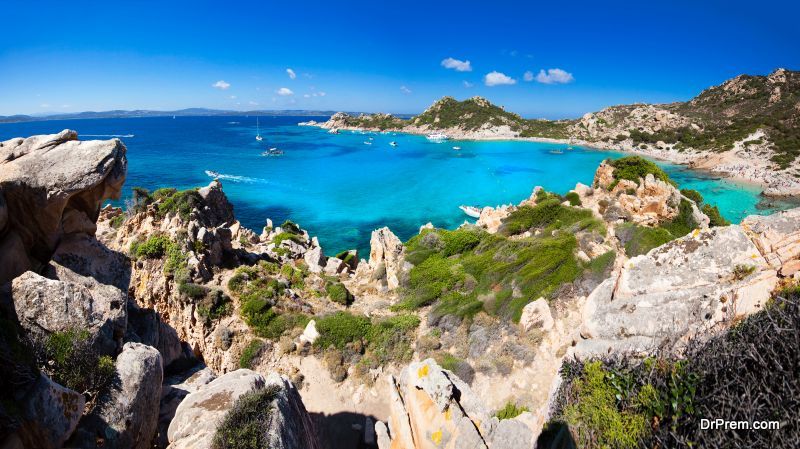
Ocean. The Mediterranean is characterized and immediately recognized by its imposing deep blue color, especially around the Greek and Croatian islands.

Predominant currents for June
Evaporation greatly exceeds
precipitation and river runoff in the Mediterranean, a fact that is central to the water circulation within the basin.
[2] Evaporation is especially high in its eastern half, causing the water level to decrease and
salinity to increase eastward.
[3] This
pressure gradient pushes relatively cool, low-salinity water from the Atlantic across the basin; it warms and becomes saltier as it travels east, then sinks in the region of the
Levant and circulates westward, to spill over the Strait of Gibraltar.
[4] Thus, seawater flow is eastward in the Strait's surface waters, and westward below; once in the open ocean, this chemically-distinct "Mediterranean Intermediate Water" can persist thousands of kilometers away from its source.
[5]
Bordering countries
Twenty-one modern states have a coastline on the Mediterranean Sea. They are:
★ '
Europe' (from west to east):
Spain,
France,
Monaco,
Italy, the island state of
Malta,
Slovenia,
Croatia,
Bosnia and Herzegovina,
Montenegro,
Albania,
Greece,
Turkey
★ '
Asia' (from north to south):
Turkey,
Syria, the island state of
Cyprus,
Lebanon and
Israel
★ '
Africa' (from east to west):
Egypt,
Libya,
Tunisia,
Algeria and
Morocco

Mediterranian coast in Israel
Several other territories also border the Mediterranean Sea (from west to east):
★ The
British overseas territory of
Gibraltar
★ The
Spanish enclaves of
Ceuta and
Melilla and nearby islands
★ The autonomous monastic state of
Mount Athos
★ The
Turkish Republic of Northern Cyprus, recognized only by
Turkey
★ The
sovereign base area of
Akrotiri and Dhekelia
★ The
Gaza Strip (governed by the
Palestinian National Authority)
Macedonia,
Portugal,
San Marino,
Serbia, and the
Vatican City, although they do not border the sea, are often considered Mediterranean countries in a wider sense due to their Mediterranean climate, fauna and flora, and their cultural affinity with other Mediterranean countries.
Subdivisions
The Mediterranean Sea is sub-divided into a number of smaller seas, each with their own designation (from west to east):
★ the
Alboran Sea, between
Spain and
Morocco,
★ the
Balearic Sea, between mainland
Spain and its
Balearic Islands,
★ the
Sea of Sardinia, between
Sardinia and
Balearic Islands,
★ the
Ligurian Sea between
Corsica and
Liguria (Italy),
★ the
Tyrrhenian Sea enclosed by
Sardinia,
Italian peninsula and
Sicily,
★ the
Sea of Sicily between
Sicily and
Tunisia,
★ the
Adriatic Sea between the
Italian peninsula and the
Balkan peninsula
★ the
Ionian Sea between
Italy,
Greece, and
Albania,
★ the
Libyan Sea between
Libya and
Crete,
★ the
Aegean Sea between Greece and Turkey, with
★
★ the
Thracian Sea in its north,
★
★ the
Myrtoan Sea between the
Cyclades and the
Peloponnesos,
★
★ the
Sea of Crete north of Crete
★ the
Sea of Marmara between the
Aegean and
Black Seas
★ the
Cilician Sea between
Turkey and
Cyprus
Many of these smaller seas feature in local myth and folklore and derive their names from these associations. In addition to the seas, a number of
gulfs and
straits are also recognised:
★ the
Saint George Bay in Beirut, Lebanon
★ the
Strait of Gibraltar, connects the
Atlantic Ocean to the Mediterranean Sea and separates
Spain from
Morocco
★ the
Bay of Gibraltar, at the southern end of the
Iberian Peninsula
★ the
Gulf of Corinth, an enclosed sea between the Ionian Sea and the
Corinth Canal
★ the
Saronic Gulf, the gulf of
Athens, between the Corinth Canal and the
Mirtoan Sea
★ the
Thermaic Gulf, the gulf of
Thessaloniki, located in the northern Greek region of
Macedonia
★ the
Kvarner Gulf,
Croatia
★ the
Gulf of Lion, south of
France
★ the
Gulf of Valencia, east of
Spain
★ the
Strait of Messina, between
Sicily and the toe of
Italy
★ the
Gulf of Genoa, northwestern Italy
★ the
Gulf of Venice, northeastern Italy
★ the
Gulf of Trieste, northeastern Italy
★ the
Gulf of Taranto, southern Italy
★ the
Gulf of Salerno, southwestern Italy
★ the
Gulf of Gaeta, southwestern Italy
★ the
Gulf of Squillace, southern Italy
★ the
Strait of Otranto, between
Italy and
Albania
★ the
Gulf of Haifa, between
Haifa and
Akko,
Israel
★ the
Gulf of Sidra, between
Tunisia and
Cyrenaica (eastern Libya)
★ the
Strait of Sicily, between
Sicily and
Tunisia
★ the
Corsica Channel, between
Corsica and
Italy
★ the
Strait of Bonifacio, between
Sardinia and
Corsica
★ the
Gulf of İskenderun, between
İskenderun and
Adana (
Turkey)
★ the
Gulf of Antalya, between west and east shores of Antalya (
Turkey)
★ the
Gulf of Kotor, on the coast of
Montenegro
★ the Malta Channel, between Sicily and Malta
Geology
The geology of the Mediterranean is complex, involving the break-up and then collision of the African and Eurasian plates and the
Messinian Salinity Crisis in the late
Miocene when the Mediterranean dried up.
The Mediterranean Sea has an average depth of 1,500
m and the deepest recorded point is 5,267 meters (about 3.27 miles) in the
Calypso Deep in the
Ionian Sea. The coastline extends for 46,000
km. A shallow submarine ridge (the Strait of Sicily) between the island of
Sicily and the coast of
Tunisia divides the sea in two main subregions (which in turn are divided into subdivisions), the Western Mediterranean and the Eastern Mediterranean. The Western Mediterranean covers an area of about 0.85 million
km² and the Eastern Mediterranean about 1.65 million
km².
Geodynamic
The
geodynamic evolution of the Mediterranean Sea was provided by the convergence of European and African plates. This process was driven by the differential spreading along the Atlantic ridge, which led to the closure of the Tethys Ocean and eventually to the Alpine orogenesis. However, the Mediterranean also hosts wide extensional basins and migrating tectonic arcs, in response to its land-locked configuration.
Eastern Mediterranean: in middle Miocene times, the collision between the Arabian microplate and Eurasia led to the separation between the Tethys and the Indian Oceans. This process determined profound changes in the oceanic circulation patterns, which shifted global climates towards colder conditions. The Hellenic Arc, which has a land-locked configuration, underwent a widespread extension for the last 20 Myr due to a slab roll-back process. In addition, the Hellenic Arc experienced a rapid rotation phase during the Pleistocene, with a counterclockwise component in its eastern portion and a clockwise trend in the western segment.
Central Mediterranean: the opening of small oceanic basins of the central Mediterranean follows a trench migration and back-arc opening process that occurred during the last 30 Myr. This phase was characterized by the counterclockwise rotation of the Corsica-Sardinia block, which lasted until the Langhian (ca.16 Ma), and was in turn followed by a slab detachment along the northern African margin. Subsequently, a shift of this active extentional deformation led to the opening of the Tyrrenian basin.
Western Mediterranean: Since Mesozoic to
Tertiary times, during convergence between Africa and Iberia, it developed the Betic-Rif mountain belts. Tectonic models for its evolution include: rapid motion of
Alboran microplate,
subduction zone and radial extentional collapse caused by convective removal of lithosferic mantle. The development of these intramontane Betic and Rif basins led to the onset of two marine gateways which were progressively closed during the late Miocene by an interplay of tectonic and glacio-eustatic processes.
Paleoclimatic
Because of its peculiar latitudinal position and its land-locked configuration, the Mediterranean is especially sensitive to astronomically induced climatic variations, which are well documented in its sedimentary record. Since the Mediterranean is involved in the deposition of eolian dust from the
Sahara during dry periods, whereas riverine detrital input prevails during wet ones, the Mediterranean marine
sapropel-bearing sequences provide high-resolution climatic information. These data have been employed in reconstructing astronomically calibrated time scales for the last 9 Ma of the earth's history. Furthermore, the exceptional accuracy of these paleoclimatic records improved our knowledge of the earth's orbital variations in the past.
Paleoenvironmental analysis
Its semi-enclosed configuration makes the oceanic gateways critical in controlling circulation and environmental evolution in the Mediterranean Sea. Water circulation patterns are driven by a number of interactive factors, such as climate and bathymetry, which can lead to precipitation of
evaporites. During late Miocene times, a so-called "Messinian Salinity Crisis" (MSC hereafter) occurred, which was triggered by the closure of the Atlantic gateway. Evaporites accumulated in the
Red Sea Basin (late
Miocene), in the Carpatian foredeep (middle Miocene) and in the whole Mediterranean area (
Messinian).
An accurate age estimate of the MSC—5.96 Ma—has recently been astronomically achieved; furthermore, this event seems to have occurred synchronously. The beginning of the MSC is supposed to have been of tectonic origin; however, an astronomical control (eccentricity) might also have been involved. In the Mediterranean basin, diatomites are regularly found underneath the evaporitic deposits, thus suggesting (albeit not clearly so far) a connection between their geneses.
The present-day Atlantic gateway, i.e. the
Strait of Gibraltar, finds its origin in the early Pliocene. However, two other connections between the Atlantic Ocean and the Mediterranean Sea existed in the past: the
Betic Corridor (southern
Spain) and the
Rifian Corridor (northern
Morocco). The former closed during
Tortonian times, thus providing a "Tortonian Salinity Crisis" well before the MSC; the latter closed about 6 Ma, allowing exchanges in the mammal fauna between
Africa and
Europe.
Nowadays, evaporation is more relevant than the water yield supplied by riverine water and precipitation, so that salinity in the Mediterranean is higher than in the Atlantic. These conditions result in the outflow of warm saline Mediterranean deep water across Gibraltar, which is in turn counterbalanced by an inflow of a less saline surface current of cold oceanic water.
In the last few centuries, mankind has done much to alter Mediterranean geology. Structures have been built all along the coastlines, exacerbating and rerouting erosional patterns. Many pollution-producing boats travel the sea that unbalance the natural chemical ratios of the region. Beaches have been mismanaged, and the overuse of the sea's natural and marine resources continues to be a problem. This misuse speeds along and/or confounds natural processes. The actual geography has also been altered by the building of dams and canals.
The Mediterranean was once thought to be the remnant of the
Tethys Ocean. It is now known to be a structurally younger ocean basin known as
Neotethys. Neotethys formed during the Late
Triassic and Early
Jurassic rifting of the African and Eurasian
plates.
Ecology and global warming
As a result of the drying of the sea during the
Messinian Salinity Crisis[6], the marine biota of the Mediterranean are derived primarily from the
Atlantic Ocean. The North Atlantic is considerably colder and more nutrient-rich than the Mediterranean, and the marine life of the Mediterranean has had to adapt to its differing conditions in the five million years since the basin was reflooded.
The opening of the
Suez Canal in 1869 created the first salt-water passage between the Mediterranean and
Red Seas. The Red Sea is higher than the Eastern Mediterranean, so the canal serves as a
tidal strait that pours Red Sea water into the Mediterranean. The
Bitter Lakes, which are hypersaline natural lakes that form part of the canal, blocked the migration of Red Sea species into the Mediterranean for many decades, but as the salinity of the lakes gradually equalized with that of the Red Sea, the barrier to migration was removed, and plants and animals from the Red Sea have begun to colonize the Eastern Mediterranean. The Red Sea is generally saltier and more nutrient-poor than the Atlantic, so the Red Sea species have advantages over Atlantic species in the salty and nutrient-poor Eastern Mediterranean. Accordingly, Red Sea species invade the Mediterranean biota, and not vice versa; this phenomenon is known as the
Lessepsian migration (after Ferdinand de Lesseps, the French engineer) or
Erythrean invasion. The construction of the
Aswan High Dam across the
Nile River in the 1960s reduced the inflow of freshwater and nutrient-rich silt from the Nile into the Eastern Mediterranean, making conditions there even more like the Red Sea and worsening the impact of the
invasive species.
Invasive species originating from the Red Sea and
introduced into the Mediterranean by the construction of the canal have become a major component of the Mediterranean ecosystem and have serious impacts on the Mediterranean ecology, endangering many local and
endemic Mediterranean species. Up to this day, about 300 species native to the Red Sea have already been identified in the Mediterranean Sea, and there are probably others yet unidentified. In recent years, the Egyptian government's announcement of its intentions to deepen and widen the canal have raised concerns from
marine biologists, fearing that such an act will only worsen the invasion of Red Sea species into the Mediterranean, facilitating the crossing of the canal for yet additional species
[7].
Pollution in this region has been extremely high in the past couple years. In just one year, 1,000,000 tons of sewage has been dumped directly into the Mediterranean Sea. Also, many marine species, such as the
Mediterranean Monk Seal, have been almost wiped out because of the pollution there. The Monk Seal has been placed as one of the top ten
endangered species in the world.
Global warming could trigger
hurricanes over the Mediterranean Sea.
[8]
References
1. entry μεσόγαιος at Liddell & Scott
2. Pinet, Paul R. (1996) Invitation to Oceanography, St Paul, MN: West Publishing Co., ISBN (3rd ed.), p.202
3. Pinet, p. 206
4. Pinet, pp. 206–7
5. Pinet, p. 207
6. Hsu K.J., "When the Mediterranean Dried Up" ''Scientific American'', Vol. '227', December 1972, p32
7. Galil, B.S. and Zenetos, A. (2002). A sea change: exotics in the eastern Mediterranean Sea, in: Leppäkoski, E. et al. (2002). ''Invasive aquatic species of Europe: distribution, impacts and management''. pp. 325-336.
8. Warming may bring hurricanes to Mediterranean Ben Hirschler
See also
★
Mediterranean Basin
★
Mediterranean climate
★
Mediterranean diet
★
Mediterranean forests, woodlands, and shrub
★
Mediterranean Games
★
Mediterranean race
★
Mediterranean sea (
oceanography term)
★
Mediterranean Union
★
Familial Mediterranean fever
★
History of the Mediterranean region
★
Holy League (Mediterranean)
★
Inland Sea, which is sometimes named after the Japanese Mediterranean Sea
★
List of islands in the Mediterranean
★
Suez Canal
External links
★
Greenpeace campaign "Defending Our Mediterranean": Threats, Solutions and Photo Petition
★
Planblue - Environment and Development in the Mediterranean Region