

In a previous article I had mentioned how I had to leave my home city of Toronto to find snow this year. With temperatures barely falling below zero centigrade, and only trace amounts of snowfall the entire season, I was experiencing winter withdrawals. I’m an avid outdoors person who takes advantage of all four seasons in Canada, winter being no exception. After my two previous snowy excursions to Blue Mountain just north of Toronto, and the mountainous ranges of Vermont, I decided to go for a third adventure.
As with Vermont, I was able to easily get myself surrounded by snow in just over an hour, once again with Porter Airlines flying non-stop into Quebec City. I’ve been to this beautiful historic walled city many times, and upon landing I immediately get that European feeling. Being there in the depth of February is typically quite cold and blistery, but as I exited the airport I could feel the warmth of the shining sun above and the unusually mild temperatures were an added bonus. As with other places, this year was different, however they still had plenty of snow on the ground.
I caught a taxi and in less than half an hour I was checking into my room at Stoneham Mountain Resort for a couple days of winter wonderland. I actually chose to do a midweek escape which is so much better in more ways than one. There are way less people, meaning shorter lift line ups and more run time on the mountains, and special overnight packages usually offer significant savings. I had never been to Stoneham before, but had heard great things about the mountains and it was also the location of the Snowboard Jamboree World Cup Finals, which I had been wanting to check out for the past couple years.
Over the course of the week, boarders from around the world took to the slopes to compete for first prize in various categories, such as Slopestyle, Halfpipe, Parallel Giant Slalom, and Snowboard Cross. It’s quite amazing watching these racers zoom down at tremendous speeds, ripping around sharp corners, leaping into the air, and twisting around in circles midair. Although these males and females are the best of the best from around the world, the attendance to watch such talent was quite sparse. I was able to get up front and centre to every competition, and it’s all entirely free to attend as a spectator.
Stoneham has had the privilege of hosting the World Cup several years previously, and next year they are the chosen location for the 2013 World Championships. As a result of this prestigious honour, the Snowboard Jamboree organizers at Gestev will be adding one additional discipline to the competition, only adding to the excitement and desirable location for such an event. Each race has to be carefully constructed to International Ski and Snowboard Federation Standards. In addition to the competitions at Stoneham, Quebec City has one of the most exciting events right in the heart of downtown. Big Air pits boarders against each other on a make-shift ramp built between various dwellings, roadways, and overhead bridges on the same site where Cirque du Soleil does their annual summer outdoor series. There are also great parties to be found, a fashion show, and many more winter festivities throughout the week. Gestev are also the organizers of several other events including the upcoming Red Bull Crashed Ice happening March 15th to 17th this year in Quebec City.
Although it’s only a short distance from Quebec City, the ski in/ski out advantages of staying onsite at Stoneham Mountain Resort are definitely worth it. The property is quite small in comparison to other larger ski resorts, but the recently renovated accommodations are well suited for families, groups, and gear storage. There’s also a rental shop and training school onsite making it perfect for beginners to try out something new. Surrounded by professional snowboarders, I decided to test my own snowboarding skills once again. I chose to do a minimum 90 minute lesson with one of the instructors just to get a basic understanding of the principles required, which are much different than skiing. Although, I’m still not able to race down the same runs on a board that I do with my skis, I feel I made some improvements this season.
During my stay I also had a chance to ski down several different runs of varying levels, from the simpler green and blues to the more challenging blacks. I never made it over to ‘the forties’ side of the resort which is where the majority of the black diamond runs are located, however I did end up skiing down ‘Rock n Roll’, one that was actually used the day before by the World Cup snowboarders. This was more by accident than choice, as I rode up the lift to the top to get one more run in before night fall, but the green and blue routes had been closed for snow grooming. I asked a couple of the staff on the trails which was the easiest way down, and they pointed to the black diamond ‘Rock n Roll’ and informed me, “That’s the only way down. Bonne Chance!”
There are 39 different trails throughout the system spread out over two separate mountains, which are actually connected and can be skied between along the summits. As well, 19 of the trails are lit for night skiing, which is actually quite popular with the locals. A season pass can be bought fairly cheaply and allows unlimited skiing every night the whole season long from 4:30pm to 9:30pm. In addition to the great skiing and snowboarding opportunities, there’s plenty of marked snowshoe trails, a large skating rink, year round geocaching, and excellent terrain parks for the truly adventurous. When it’s time for a break, a quiet night can be found at the Feu-Follet Restaurant, or a livelier après-ski vibe can be had at the Quatre-Foyers Bar with DJ’s and live entertainment on selected nights. The actual village of Stoneham is a five minute drive away, and is a great stop to grab munchies for the room.
I found Stoneham to be very affordable and convenient to reach. They have a slew of activities planned throughout the year, including March Break and Easter. I chatted with a few individuals who had planned an annual family retreat to the property for the past 28 years, with this year nearly 100 members in attendance. Despite what maybe happening outside your door right now, there will be snow in the mountains until at least April, making for the most excellent spring time outdoor experiences.
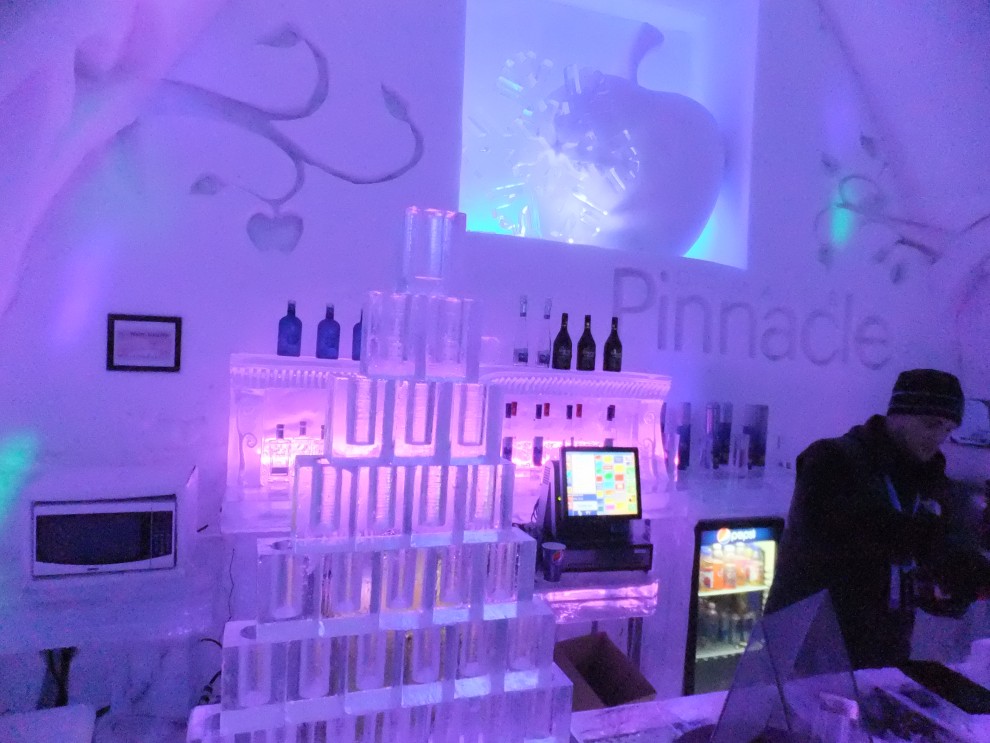
If time allows, here’s a list of other winter adventures that shouldn’t be missed. As well, a visit to the Ice Hotel can be done quite easily as it is now conveniently located approximately half way between Quebec City and Stoneham. I did an overnight stay at the property at the previous location further away from the city in Duchesnay, and I would highly recommend it for those with a bit of an adventurous side to them. It has an outdoor slide and skating rink, indoor bar and art gallery, hot tubs and sauna, and a chapel where many choose to freeze the knot. A couple from Dubai got married there this year, and there’s one Quebec family that has done an overnight stay every year since the hotel first opened back in 2001. This is definitely the best time of year to embrace both the dawn of a new season, with what remains of the current one.
More Information
Stoneham – Accommodations, rental info, ski conditions, and more – www.ski-stoneham.com
Snowboard Jamboree – Website listing of events – www.snowboardjamboree.com
Gestev – Quebec organization promoting outdoor sports and events – www.gestev.com
FIS – International Ski and Snowboard Federation – www.fis-ski.com
Snowboard Canada – National publication on snowboarding – www.snowboardcanada.com/
Canada Snowboard – Governing body for snowboarding – www.canadasnowboard.com
Quebec Tourism – General information on the province – www.quebecregion.com/en
Porter Airlines offers daily service from Toronto’s Billy Bishop City Centre Airport to Quebec City, with connections from the rest of the ever expanding flight network. Watch for Porter Escapes to begin offering vacation packages in the first half of 2012.
Porter – www.flyporter.ca